

Agricultural Robots and H-2A
March 27, 2026
By Diane Elise Charlton
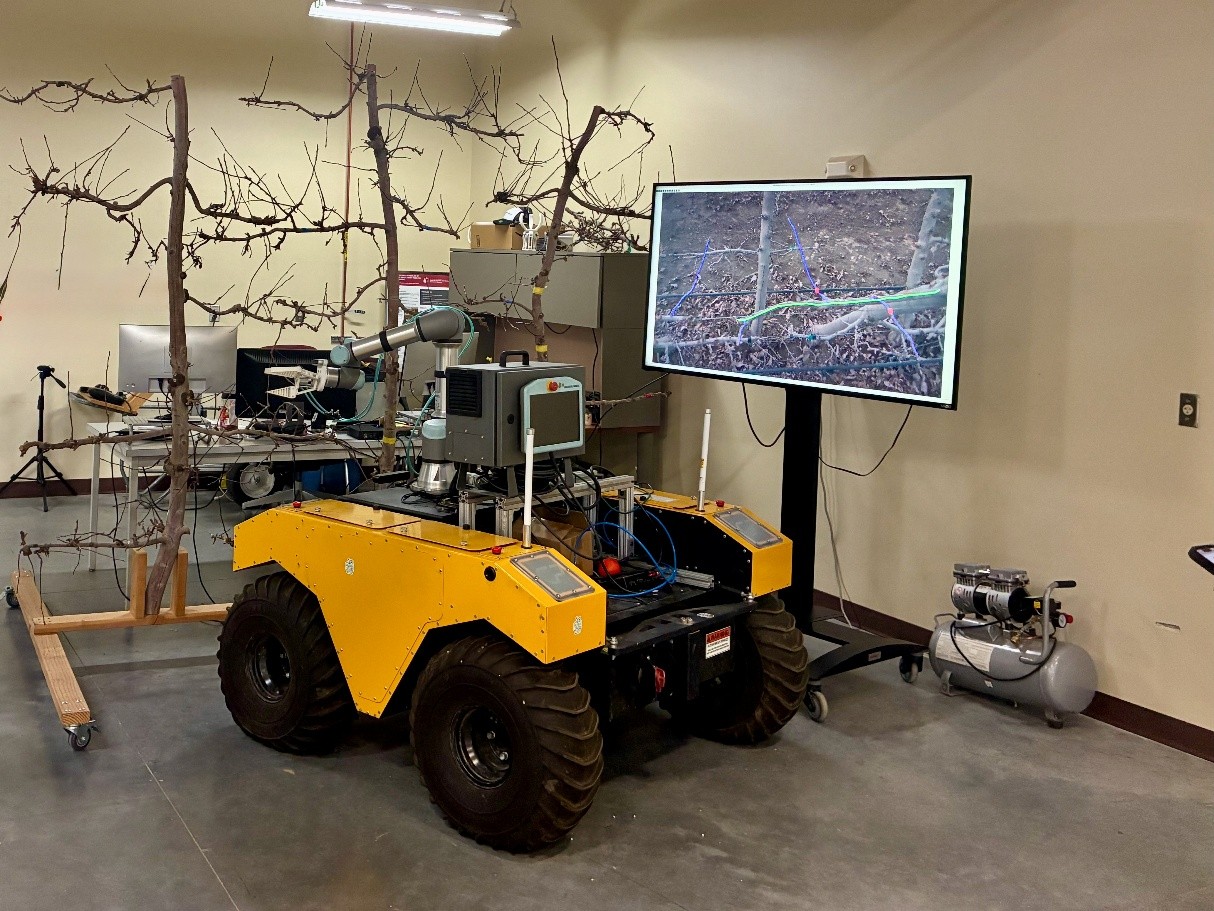
Source: Photo taken by Diane Elise Charlton
Maintaining access to a reliable source of seasonal farm labor is a primary concern
for agricultural producers. Two solutions could help ameliorate this concern: 1) Innovate
more automated technologies to perform labor-intensive tasks, and 2) Expand the H-2A
agricultural guest worker program.
We discussed both these solutions at a researcher-grower meeting in Washington State
two weeks ago. A USDA-funded project aims to develop an Automated and Integrated Mobile System (AIMS) that combines robotic apple harvesting technology with an automated in-field sorter
to remove defective apples. Current prototypes show strong progress. In recent field
trials, the robot successfully picked 70-75% of apples in the orchard, and the fastest
recorded time was 3.6 seconds per apple. Nevertheless, more field trials are needed
to determine how reliably the robot can perform and to test performance in more diverse
settings. Different orchard structures, slopes, and apple varieties could impact speed
and performance. A crew of workers will be required to pick the remaining apples that
the robot misses, but if successful, the robot could reduce the seasonal labor requirements.
Furthermore, in-field sorting could reduce large costs incurred at the packing shed
to store apples that will ultimately be culled.
Determining the economic feasibility of adopting new innovations like the robotic
apple harvester on commercial farms is challenging. Results are sensitive to assumptions
about robot speed, whether the robot causes additional fruit damage, number of workers
required to oversee the robot, and farm worker wages (See for example, Charlton et al. (2025)). Technological innovations might disrupt industry structures if there are large
economies of scale that favor consolidation. However, well-functioning rental/custom
harvest markets could help small farms remain in business.
Even if new technologies reduce labor demand during harvest, they will not eliminate
the need for seasonal farm workers. The H-2A agricultural guest worker visa program
permits producers to employ foreign guest workers for temporary or seasonal on-farm
jobs when no domestic workers are willing or able to perform the work. H-2A employment
grew from a little more than 50,000 in 2006 to nearly 400,000 in 2025.[1] In October 2025, the U.S. Department of Labor issued an Interim Final Rule, which changed the methodology for determining the Adverse Effect Wage Rate (AEWR)
and split H-2A workers into two skill- based categories with different AEWRs. According to the USCIS guidelines, employers must still apply for H-2A positions through the Department of Labor prior
to submitting to the USCIS. Employers must specify the terms of the contract and guarantee
workers at least three-fourths of the hours in the initial contract, and employers
are responsible for worker housing and transport from and return to the workers’ homes.
Despite recent reforms to the AEWR, challenges with the H-2A program still exist.
For example, many agricultural producers still struggle to find sufficient workers
to fill year-round jobs that do not qualify for H-2A. Furthermore, reports indicate
that there are insufficient resources to adequately monitor employer compliance with
labor laws, and according to personal conversations with workers in Mexico, recruiters
sometimes take workers’ passports or charge them high service fees to interview for
an H-2A visa (which is prohibited under the H-2A program).
In sum, agricultural technologies continue to evolve, but even advanced robotic innovations
cannot entirely replace human workers. Agricultural reliance on H-2A workers grew
rapidly over the past 20 years and is expected to continue. More creative solutions
to improve employer access to the H-2A program and protect worker safety during recruitment
and employment are necessary for long-term program viability.
[1]Ayoub, Samantha. January 22, 2026. “H-2A Program Use Continues to Soar.” Farm Bureau
Market Intel. https://www.fb.org/market-intel/h-2a-program-use-continues-to-soar Accessed March 25, 2026

Diane Charlton
Associate Professor
The U.S.D.A., Montana State University and Montana State University Extension prohibit discrimination in all of their programs and activities on the basis of race, color, national origin, gender, religion, age, disability, political beliefs, sexual orientation and, marital and family status. Issued in furtherance of cooperative extension work in agriculture and home economics, acts of May 8 and June 30, 1914, in cooperation with the USDA, Cody Stone, Director of Extension, Montana State University, Bozeman, MT 59717.