
Entangled Jelly Beans
Entangled Jelly Beans Downloadable PDF
This resource works great in outreach activities where you might only have 3-5 minutes with a group of individuals. If you have more time, you can dig deeper into quantum entanglement and superposition using some of the additional resources linked below! A downloadable PDF can be found above.
Introduction to the Topic:
Quantum entanglement allows particles such as electrons or photons to depend on each other such that when we measure attributes of one particle we will then know attributes of the entangled particle (no matter how far apart they are!). This is not explainable through classical physics, and Albert Einstein questioned it enough to call it “Spooky action at a distance” and that moniker has stuck around for quite some time! We now have better instruments to measure such attributes and understand this process a bit more (in fact the 2022 Nobel Prize in Physics was awarded to 3 researchers who provided evidence of entanglement).
Activity Overview:
This simplified presentation of entanglement requires students to first understand superposition. Students will learn about the difference between classical bits (which can exist only as “on/off” states of 1/0) and qubits which are able to be in states of superposition. When particles are in a state of superposition, they can also be entangled (there are methods to do this in practice, some of which resulted in the Nobel Prize, you do not need to go into the detail of how they get entangled though). One set of jelly beans should be undeniable (we use Banana and Lemon because they are more easily distinguished than others, however the “BeanBoozled®”flavors do change over time so be sure to determine your two sets ahead of time and make a chart that matches!). This set represents classical bits that are either on or off (flavored or not flavored). The second set will include jelly beans that can be two different flavors, this would mean that there is some probability that the jelly bean is one of the two flavors or “states.”
Preparation:
Be sure to present students with prior knowledge of superposition. Separate the two sets of jelly beans into “classical” on/off bits and “qubits” that are going to represent some probability of two different flavors. Ensure that there are no allergies to any ingredients in jelly beans (here are some links with more general info and an allergy FAQ if you would like).
Materials:
- Jelly beans of various flavors (in this case, cherry, lemon, banana, strawberry jam, and buttered popcorn)
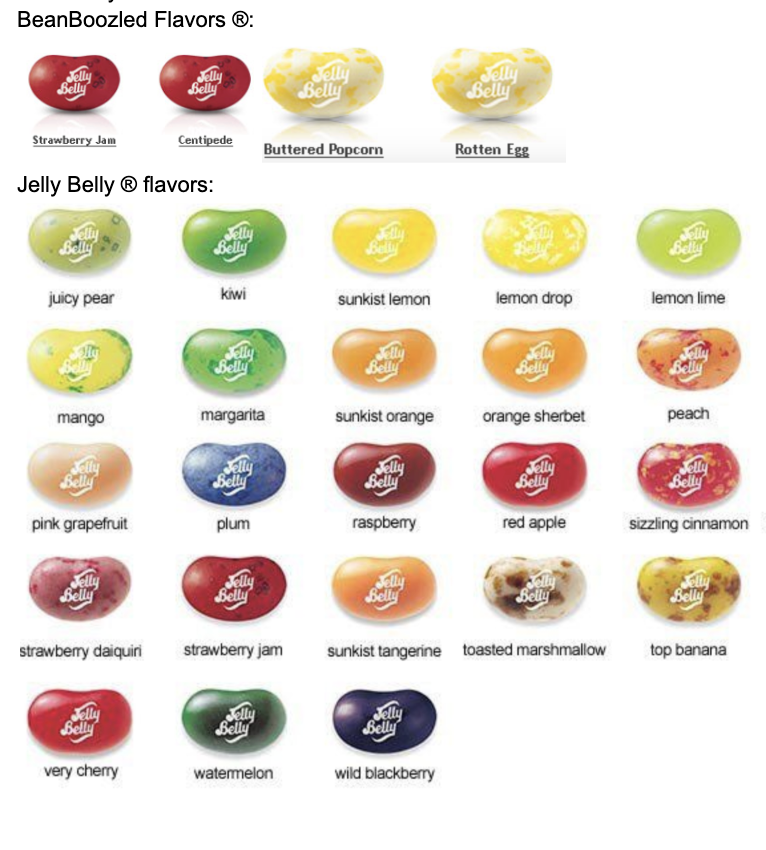
- Bean boozled® and Jelly Belly® Bean chart (an example is listed below, or you can create your own!)
Directions:
- Ask students who would like to try jelly bean “classical bits.” To play up the fun a bit you can say that you bought this set on discount and so you don’t know if there was a mistake at the factory and aren’t sure if they are flavored or not flavored. You can ask students what flavor they think it should be and then determine if the flavor is on or off (or use “1” or “0” to convey how classical bits send information).You may have just one student try all the jelly beans, or have a different student try a different flavor, or have all students try flavors.
- Now ask the students who would like to try jelly bean “qubits.” Again to play up the fun, don’t mention the entanglement at first so that the next steps become a bit of risk. You will need two students for this demo (or you can split the class in half). This should mean that one of the flavors is the unappetizing beanboozled flavor!
- To play up the fun, you should ask for the volunteers ahead of time or pass out the candy to both halves of the classroom first so they don’t realize what risk they are taking.
- Have one half of the demo try their entangled jelly bean first and report the flavor. Hopefully they say that it is the better flavor and then the other student/entangled pair will realize that they are about to eat the unappetizing one. When we do this, we end up having them eat the jelly bean and realize it is the good flavor still and we simply say that our entanglement experiment failed this time! But inevitably, there are often students who will claim to have gotten the unappetizing jelly bean which still makes it a bit fun!
- Ask students to determine which flavor the “qubits” might be. This should result in students realizing that there are two possible flavors, and one is less appetizing!
- Tell the students that these qubits are in a state of superposition between the flavor possibilities and that there is some probability of them being either flavor (what they don’t know is you control that probability and might just choose to use the more appetizing flavor always, which is what we do).
- Explain that because they can exist in a state of superposition, you can also entangle the jelly beans, because entanglement requires the state of superposition. Classical bits can’t be entangled because they can’t be in superposition. There are multiple ways to cause entanglement, based on which type of qubit particle you are using. In the first example, tell them that you have set up the entanglement so that both qubits (jelly beans) should be the same, regardless of where they are measured. For fun, you can send students to opposite sides of the room, or one student into the hallway. Ask them both to try the jelly bean qubit and confirm that it is the same flavor. Technically, you can entangle more than 2 qubits so if you’d like to use 3 students in 3 locations you can. Or splitting the classroom into half would work!
- Now move into the second method of entanglement, which entangles particles so that they are the opposite. Ask students what this would mean for the jelly beans.
Additional resources:
- https://scienceexchange.caltech.edu/topics/quantum-science-explained/entanglement
- https://science.nasa.gov/what-is-the-spooky-science-of-quantum-entanglement/
- https://www.astronomy.com/science/what-is-quantum-entanglement-a-physicist-explains-einsteins-spooky-action-at-a-distance/
- https://www.nobelprize.org/prizes/physics/2022/popular-information/
This resource was provided by the MSU Science Math Resource Center using resources from the MSU Applied Quantum CORE funded by the Air Force Office of Scientific Research. The work was adapted from https://q12education.org/project/measurement-and-observation
Note: the images below are from Jelly Belly® and the flavors may change over time.