

Future City: Fire Resilient Future
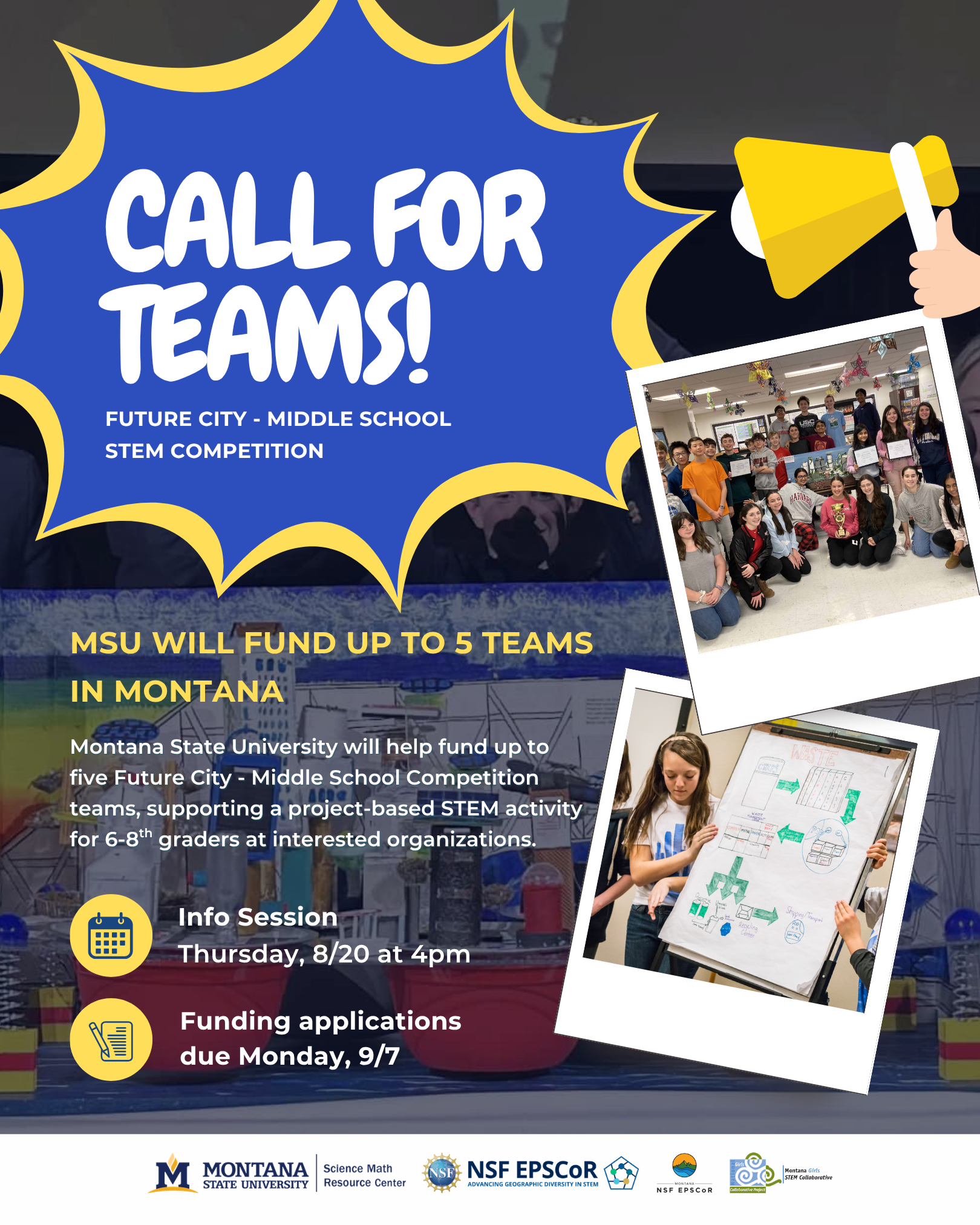
The Science Math Resource Center, SMART FIRES, and the Montana Girls STEM Collaborative are offering funding support for up to five Future City Competition Middle School teams to join a pilot program in Montana in Fall 2026.
What is Future City?
 Future City challenges students to answer a big question: How can we create a better
future? Working in teams, 6th–8th grade students partner with an educator and a volunteer
STEM mentor to investigate a real-world engineering challenge and develop innovative
solutions through city design. Throughout the program, students research, plan, and
design a city of the future that addresses the annual theme.
Future City challenges students to answer a big question: How can we create a better
future? Working in teams, 6th–8th grade students partner with an educator and a volunteer
STEM mentor to investigate a real-world engineering challenge and develop innovative
solutions through city design. Throughout the program, students research, plan, and
design a city of the future that addresses the annual theme.
Teams complete four major project components:
- A 1,500-word city essay describing their solution
- A scale model built primarily from recycled materials
- A project plan documenting their design process
- A presentation and question-and-answer session with judges
In January, teams showcase their work at a Regional Competition. Regional winners advance to the Future City Finals, held in February 2027, where they compete with top teams from across the world.
Regional competitions near Montana include:
- Idaho: January 23, 2027 at Boise State University, Boise, ID
- Wyoming: January 23, 2027 at Casper College, Casper, WY
- North Dakota: TBD, Bismarck, ND
- South Dakota: TBD
This year’s theme is Fire Resilient Future:
Design a resilient future city that can prevent, protect, and recover from urban wildfires.
How Future City Works
 Each fall, teams (comprising at least three students, an educator, and a volunteer
mentor) work together to turn their vision of a futuristic city into reality. They
will imagine what it would be like to walk down the main street of a city 100 years
from now. What would they see, hear, smell, and feel? Building on this creative foundation,
they design a city that addresses today’s most critical sustainability challenges
with innovative solutions.
Each fall, teams (comprising at least three students, an educator, and a volunteer
mentor) work together to turn their vision of a futuristic city into reality. They
will imagine what it would be like to walk down the main street of a city 100 years
from now. What would they see, hear, smell, and feel? Building on this creative foundation,
they design a city that addresses today’s most critical sustainability challenges
with innovative solutions.
As middle school students develop their cities, they:
- Apply the engineering design process and project management to tackle a large-scale project;
- Use math and science to solve real-world problems;
- Enhance their teamwork and problem-solving skills;
- And much more!
Future City is designed to align with academic standards, including:
- Common Core Standards: Science and Technical Literacy
- Common Core: ELA
- Common Core: Mathematics
- Next Generation Science Standards
- Benchmarks for Science Literacy
- Principles and Standards for School Mathematics
Competition Deliverables
- City essay (54 pts): Teams describe the unique attributes of their city and their solution to the annual challenge (1,500-word max.)
- City model (65 pts): Teams build a physical model of their city (in one piece or multiple segments) using recycled materials and include one moving part.
- Presentation / Q&A (72 pts): Teams have seven minutes to present their city’s futuristic innovations. Teams then answer questions for a panel of STEM professionals.
- Project plan (10 pts): Teams develop and use a project plan to help them stay organized and focused.
Apply For Funding
MSU Future City team funding includes:
- Team registration fees
- Background check fees
- $100 for Future City supplies
- $300 regional travel support
- $500 coach stipend
To be considered for MSU funding, applicants must complete and submit an application by Monday, September 7th:
An informational session will be held online on Thursday, August 20 at 4 pm.
Stay in touch by joining our Future City interest list: https://bit.ly/msu-futurecities
Eligibility Criteria
Applicants must meet the following criteria:
- Must be a youth-serving organization in Montana (e.g., school, afterschool program, 4-H club, Girl/Boy Scouts group, Boys and Girls Club, etc).
- Demonstrate a commitment to run a Future City team and compete in a regional competition in January.
- Meet each competition deliverable on time.
- Establish a coach, ideally with a STEM interest or background, with a commitment to mentoring students, letting students lead, and guiding them through their project.
- Hold the ability to meet ~once a week for 2-3 hours.
- Have access to recycled materials.
- Identify a place(s) to meet, build a model, and get messy.
- Have a minimum of three middle schoolers in the team (no maximum, teams can even be 40 students!).
- Demonstrate the ability to fund or find funding to support regional competition travel. Teams will travel to their closest regional competition (Wyoming, North Dakota, South Dakota, or Idaho).
Selection Criteria
Applicants will be selected by the following:
- Student need and access
- Coach commitment and capacity
- Student recruitment plan
- Community impact
- Organizational support
Teams awarded with MSU funding will be notified by Friday, September 11 and are expected to begin working with their team towards the competition shortly after.
For more information on Future City Competition, visit https://futurecity.org/future-city-middle-school/
Questions?
Contact smrc@montana.edu