

Montana Family Forest 2022 Newsletter
Tree Crowns, what do they tell us?
Issue No. 49 Spring 2022
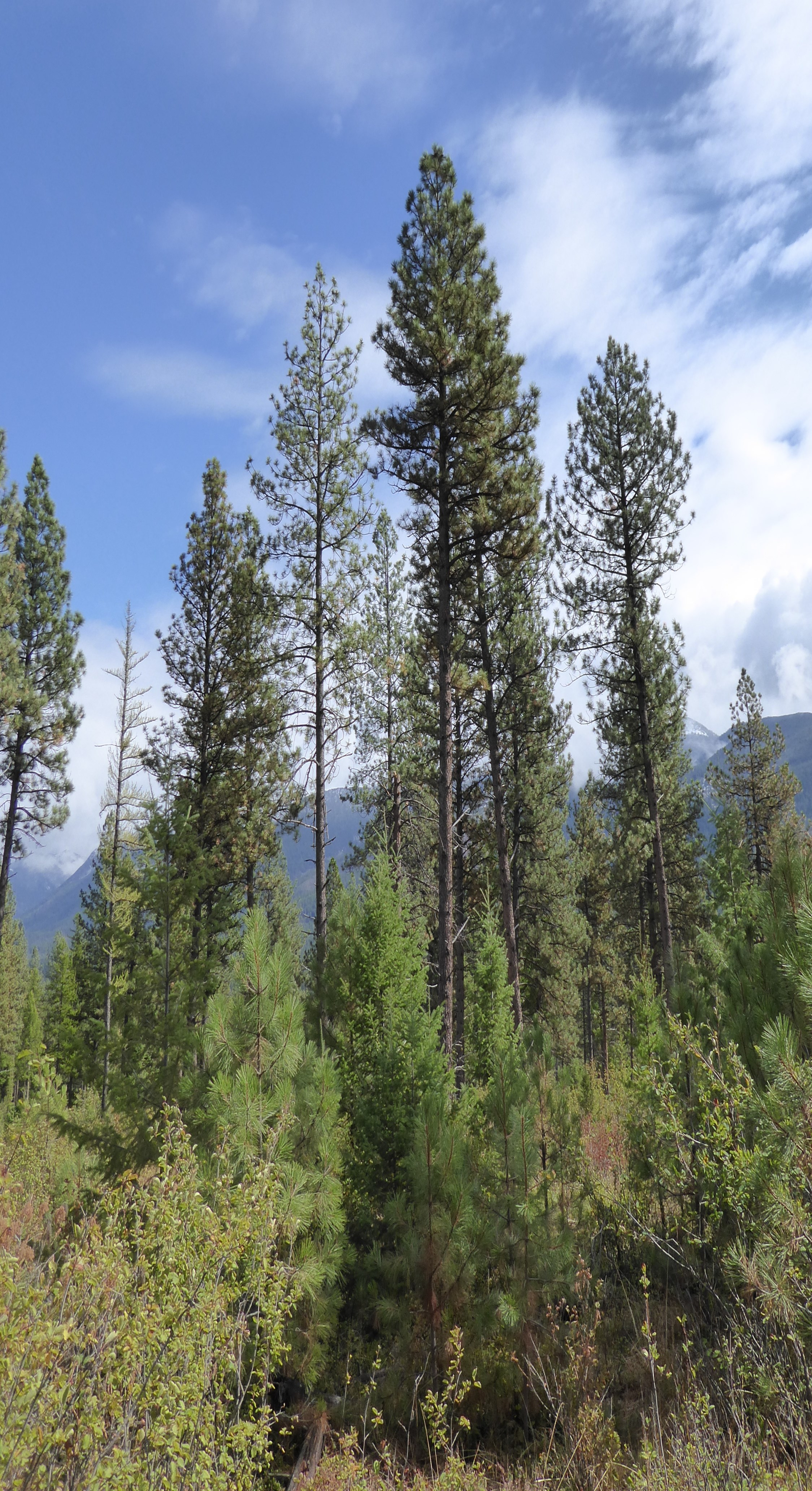
About the Cover
By: Peter Kolb - MSU Extension Forestry Specialist
If you are reading this newsletter, it is almost certain that you love trees and forests. Surveys have given us a long list of why people feel the way they do about this subject, ranging from the spiritual to the utilitarian. I liken the love of forests to the love of books and libraries. Books can give us endless information about just about anything, let us escape from reality into some enjoyable fantasy world, teach us to be better in our relations to others, learn about history, and ultimately learn about ourselves. Libraries in turn can give us a quiet place to reflect and learn. If you forgive the analogy, forests do pretty much the same, though first you need to learn a new language in order to “read the forest” and the ecosystem it creates. If there is an alphabet, it might be the climate, soils, geology, and tree, plant and animal species. Combinations of these make up the words, and over time they make up different chapters and plots within the novel that is your forest. Tree crowns are a reflection of the genetics and life history of each tree (or character) on that site, and combinations of crowns tell us a little about interactions and story of that site. The cover shows us some really big strong healthy ponderosa pines, surrounded by others that have some other characteristics (thin crown, wide crown, lighter needles, etc). We know that ponderosa pines need full sunlight to germinate and grow—so aging the trees tells us when that location had a major disturbance that created sunny bare mineral soil. Maybe a lightning strike caused fire? Or maybe some fire set by the Salish or Kootenai people? But why do the trees look different with this shared history? Does the thin crown tree have a disease that will infect the other trees? Maybe it just is in a different phase of its life? Poor nutrition, genetics, a cold? And then there is the larch—looking a little ragged compared to the ponderosa pines— but why? Is this the way larch is supposed to look? And what about the tree “kids” in the foreground? Will they turn out like their parents, or do they need something new that their parents did not have when they were younger? As forest managers we have a population of individuals we are responsible for, and that most of us want to see get bigger, stronger and healthier, and that provide us with the pleasure of seeing them grow and give us not only the experience, but also the wood products that provide us with the means to do more for the forest. Tree crowns can tell us a lot, and hopefully this issue will give you some more information that helps figure out the characters, plot and the chapter of the book that we are a part of. And if you find you end up with more questions than answers, game on, that is always part of learning more and being a forest steward. I hope you enjoy this issue of the Montana Family Forest News!

From the Editor's Desk
This newsletter is possible through funding from the Renewable Resources Extension Act (RREA). It highlights numerous articles focused on information and resources that forest landowners can use to better their knowledge and potentially implement on their own land. The overall concept is to provide articles that capture one’s attention based on current issues and updates on various organizations on a state and national level. Our goal is to provide articles that will give important information and encourage landowners to develop new ideas towards their land. The newsletter is also available at http://forestry.msuextension.org/publications.html.
Warm regards,
Christina Oppegard
Editor
Peter Kolb
MSU Extension Forestry Specialist
Designer
Christina Oppegard
MSU Extension Program Manager
Advisor
Cindy Peterson
MSU Extension Associate Forestry Specialist
Financial Contributors
Montana Tree Farm
Montana Stewardship Foundation
Montana Forest Owners Association
Montana State University Extension Forestry

The U.S. Department of Agriculture (USDA), Montana State University and Montana State University Extension prohibit discrimination in all of their programs and activities on the basis of race, color, national origin, gender, religion, age, disability, political beliefs, sexual orientation, and marital and family status. Issued in furtherance of cooperative extension work in agriculture and home economics, acts of May 8 and June 30, 1914, in cooperation with the U.S. Department of Agriculture, Cody Stone, Director of Extension, Montana State University, Bozeman, MT 59717.