

What Can Tree Crowns Tell Us?
By: Peter Kolb - PhD MSU Extension Forestry Specialist
Trees are quite remarkable in their ability to grow as stationary organisms across a wide variety of sites, and sometimes persist there for hundred, and in rare instances, thousands of years (Picture 1). Some tree species such as ponderosa pine, lodgepole pine, limber pine, western Larch and even Douglas-fir are adaptable to growing on different and changing site conditions. Other tree species are much more sensitive to specific site conditions, and once they reach a mature size, do not adjust well to local changes (light, water, temperature) in their environment. Species with this sensitivity fall primarily into the "climax" or "shade tolerant" category such as grand and subalpine fir,Engelman spruce, western red cedar, and sometimes Douglas-fir (a complicated species).
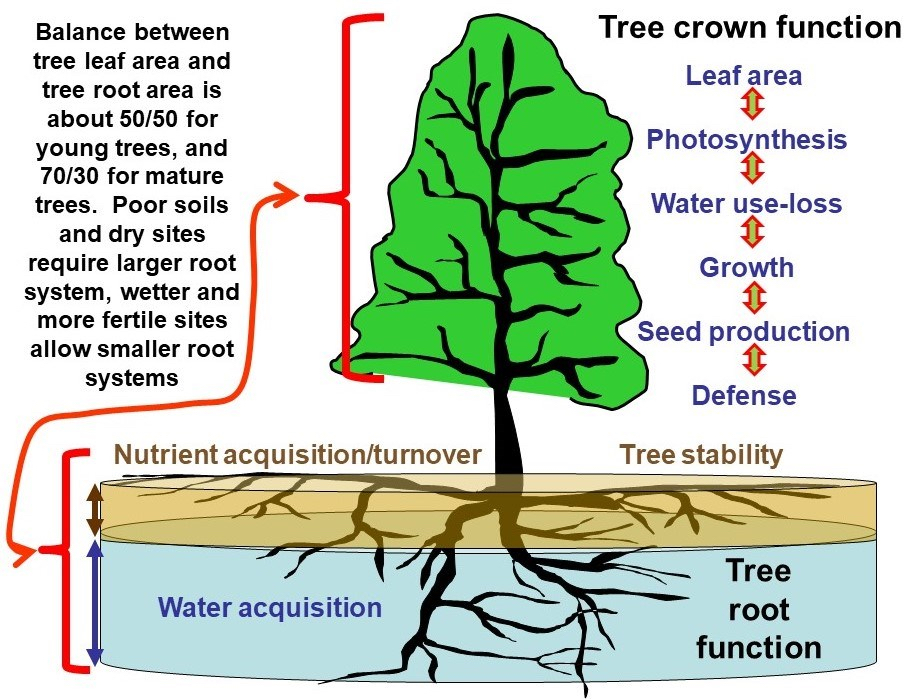
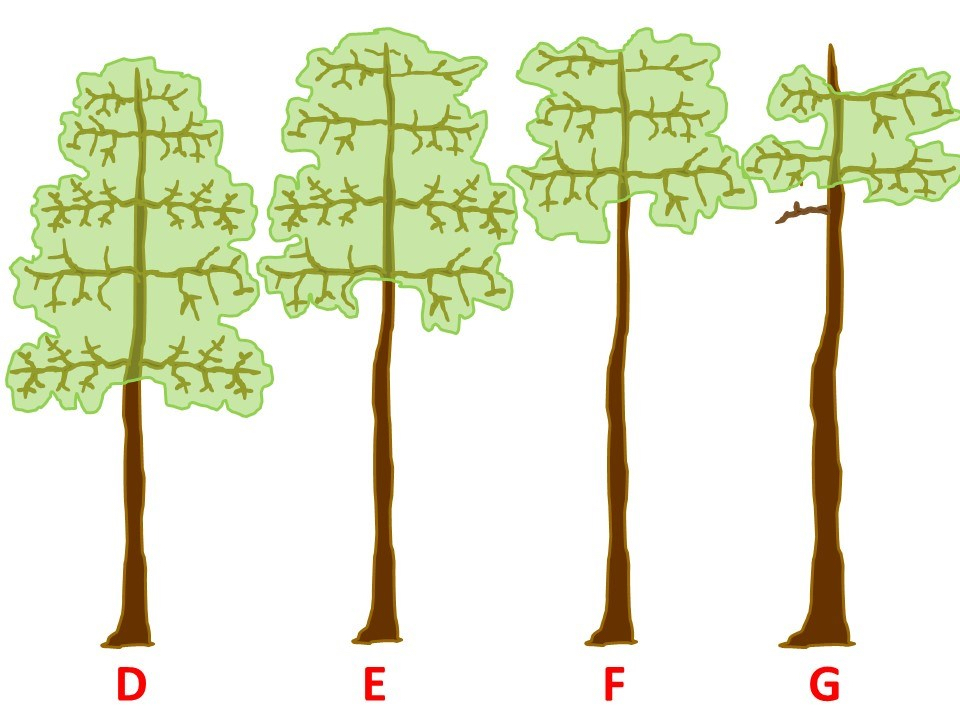
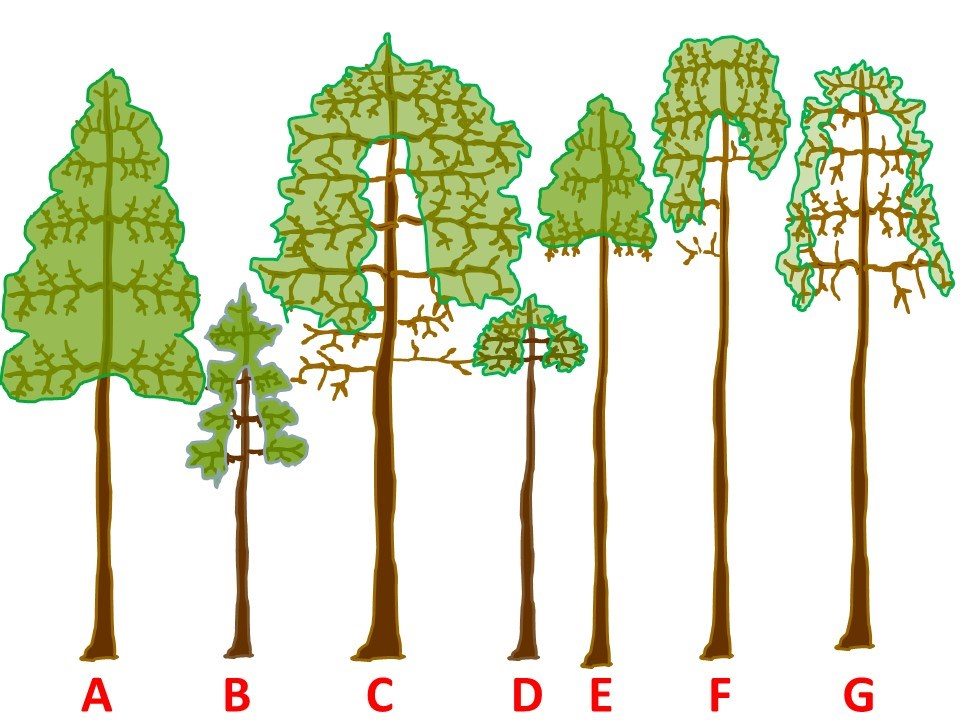
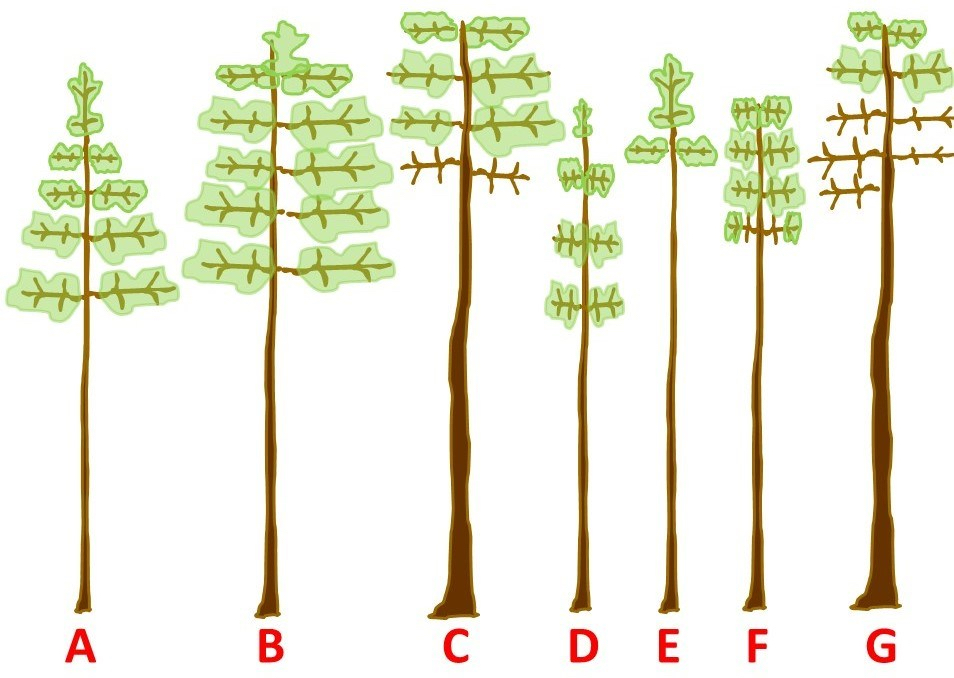
Trees go through different adaptability phases as they grow. Seed germination and early seedling survival is sensitive and dependent on specific soil moisture and temperature requirements. However, once established for a year or two, most seedlings are pretty tough at surviving changes in their local environment. It usually takes almost a decade of growth before competition with neighbors, too much sun, or too much shade starts to weaken and kill tree species that are poorly adapted to a particular site, or individuals growing in a bad spot. The sapling and pole size phase in a trees life is also when they can stagnate in dense clusters and suffer from intense competition with their neighbors. This is a critical phase for many tree species as competition for sunlight determines not only their tree shoot or “crown” development, but also determines how much energy a young tree has for stem and root growth (Picture 2). In general, a young tree’s crown size is directly proportional to its root area, as one needs the other to grow.
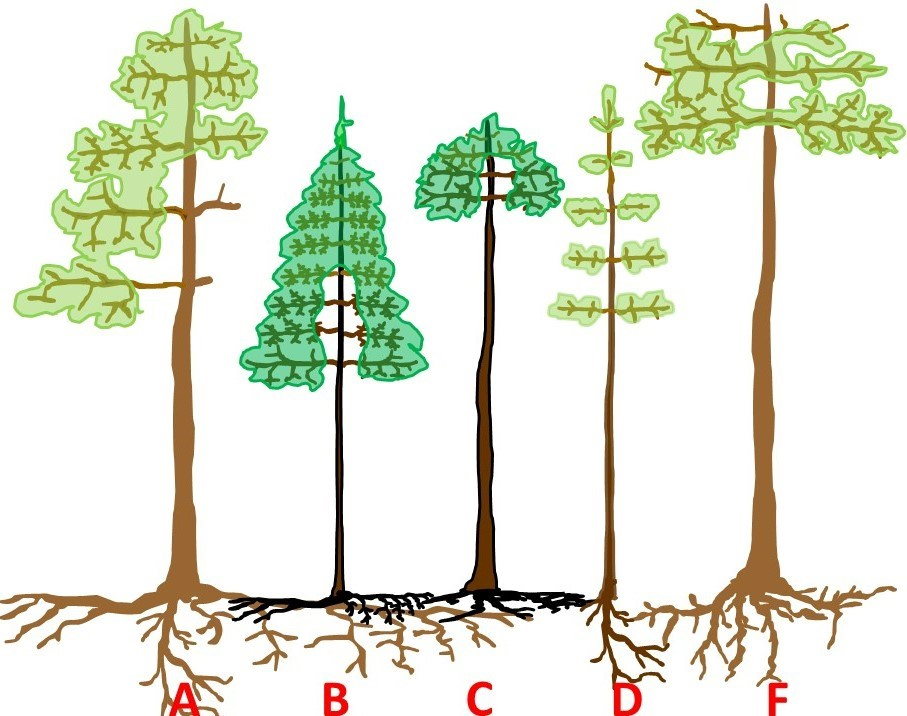
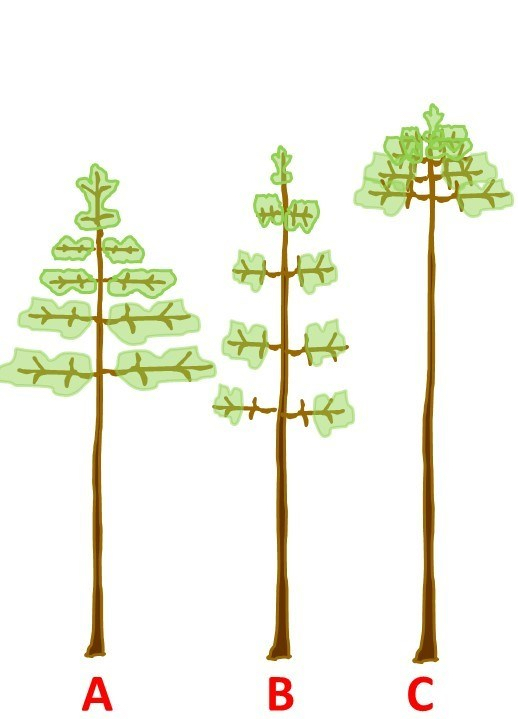
Picture 2. Tree crown shapes are determined by species light adaptations, and are also a reflection of the trees’ root system. Pioneer species do not have shade tolerant needles, and lose needles and branches that get shaded (A). They also tend to have expansive tap roots. Shade tolerant species can maintain needles and a larger functional crown in partial shade, and develop a shallower rooting structure (B). Shade tolerant species also have minimum light requirements and can stagnate from the combination of low light and soil water competition (C); a condition from which they rarely can recover. In a limited light environment pioneer species can expend more energy growing tall to reach more light, though with structural consequences (D) such as tall spindly crowns and diminished roots. As all tree species age, drought stress or root dieback from root disease will show as crown top dieback (F). Pioneer tree species can live for centuries with this condition whereas shade tolerant species cannot.
A species genetic programming (sun or shade tolerance, tap or shallow fibrous root system) is also critical and will give that species an advantage or disadvantage for any particular set of site conditions. The density and competition from the same and other species within a group of trees will further modify how an individual tree will grow, and its potential to grow bigger and healthier. Even at a young age, a trees’ individual tree crown size and shape is a good indicator of its future potential to: 1) grow larger, and 2) live longer. Thus the combination of a tree’s crown shape, size, and density, as well as taking into account that species growth characteristics, is a good measure for selecting which trees have the greatest growth potential and lifespan for any particular location.
Tree crown indices were first developed over a century ago to help foresters evaluate tree growth potential (Picture 3). There has been some difference in opinion over time regarding what crown characteristics and position are the best to leave when harvesting. The initial thought was that a tree with a dominant crown has superior growth and genetics for a site and should be left to continue to gain a greater size and as a seed source for the site. This methodology is currently used in Europe and called “Z” tree selection where younger dominant crown trees are given more space, which has been measured to promote both increased wood quality and volume growth for any given site by 10-20%.
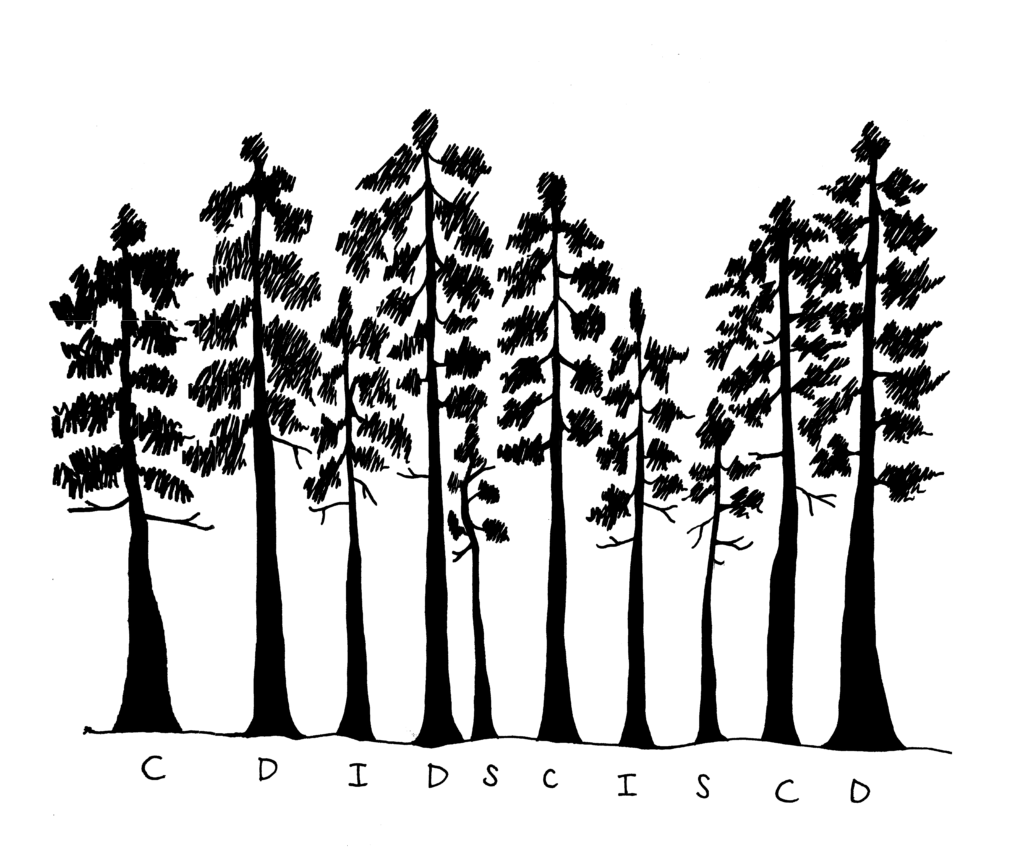
Picture 3. Open Oregon Educational Resources 5.4 Field Technique Tips for Determining Crown Class and Live Crown Ratio. D -dominant tree crown, C - codominant, I- intermediate, S-suppressed.
The other thought, often applied to more mature stands of trees, has been that dominant trees are in that position because chance has given them more light, and thus they are taller and bigger. Dominant crowns also coincides with larger stems, and they are the more valuable trees for harvest. By removing dominant trees, intermediate and suppressed trees can “release” and with more light, and less root competition for water, show increased growth rates. Stem volume calculations show that improving radial stem growth in a 14-20” diameter tree from 20 years per radial inch of growth to 10 years can increase stem volume and value by 20% within 5-15 years. This kind of “release” cut has also been widely practiced with good results.
Experience with both of the above concepts across Montana and Idaho has yielded mixed results (Picture 4). For some species and sites, leaving a mix of dominant, codominant and intermediate trees and providing them with more space has yielded excellent results (4A). More light and soil water allowed trees more resources to grow larger and remain more resistant to insects, diseases, and even fire. Alternatively, extreme removal of the more dominant trees and leaving suppressed trees to a sudden full-sunlight and wind environment can result in sunburned and stressed trees (4B). This has also been referred to as “high grading” because there is some evidence that suppressed trees might also be genetically disadvantaged for that site and produce poorly adapted offspring. At the other end of the spectrum, leaving mostly dominant and codominant trees in a wider spacing can also yield poor results (4C) where these trees suddenly decline and start to die. Clearly there is more to consider than simple crown position and dominance when developing a stand treatment
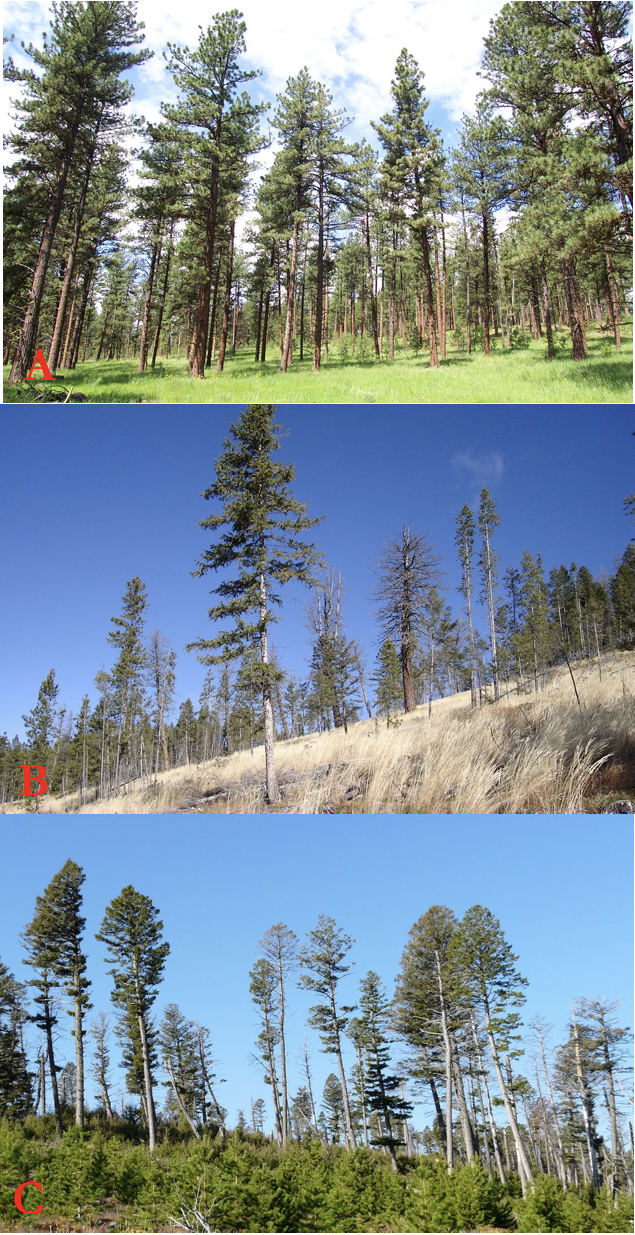
Picture 4. Selection for leaving dominant and codominant
Ponderosa pine (A), suppressed lodgepole and Douglas-fir (B), and dominant Douglas-fir
(C) with variable results.
As trees mature on any particular site, they are increasingly influenced by the specific conditions their crowns and root systems encounter. Although tree species are genetically “programed” to grow with certain characteristics, they are also opportunistic and will try to take advantage of available resources. This is why the standard genetic formula is: Phenotype (what you see) = Genetics + Environment + (Genetics x Environment). A trees crown development is a product of this formula where “environment” plays a strong role during the growth and lifespan of the tree. The interaction of root development and crown development cannot be overemphasized, although root growth and crown growth can react in almost opposite ways. Most crowns will grow larger when provided with ample light, whereas most roots systems can be less expansive when developing in highly fertile soils (such as riparian areas). Root growth reacts to resource variability within the soil. Typically roots will grow into locations where concentrations of water and nutrients are most available, much like branches will grow into gaps in a canopy where sunlight is available. Excavations around rotten old stumps that collect and sequester water in their decayed wood shows them surrounded by “sheaths” of fine roots. Similar root concentrations are often found in septic drain fields, sometimes clogging drain tiles and rendering them in need of renovation. Likewise, trees will grow fewer roots into areas that are excessively dry, obstructive (clay soils), or nutrient poor when better soils are nearby. Though in general, the better the soil resources, the better the tree height growth and crown development, and proportionally the more symmetrical and extensive the root system — within the genetic capability of the tree species (Picture 5).
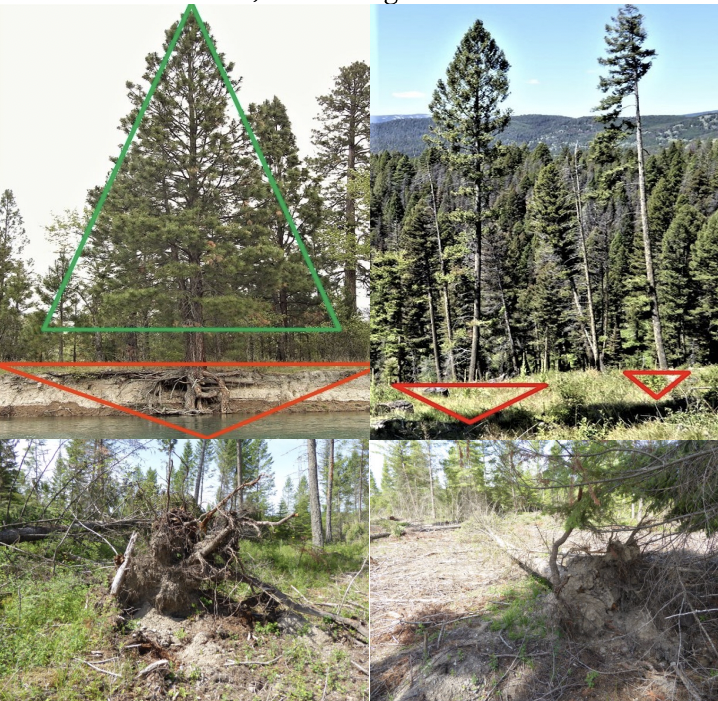 Picture 5. A ponderosa pine (top left) has an aggressive tap-root system comprised of fewer
but thicker main roots that can grow twice as wide as the tree crown width (bottom
left). Douglas-fir (top right) has a more fibrous root system that is less expansive
and can often grow one sided (bottom right) to exploit soil “hotspots” where nutrients
and water are more available. Crown size is a good indicator of root size, and wind-firmness.
Tall trees with small crowns can be very susceptible to wind-throw when too many of
their neighboring trees are removed. One sidedcrowns often indicate one-sided root
systems as well.
Picture 5. A ponderosa pine (top left) has an aggressive tap-root system comprised of fewer
but thicker main roots that can grow twice as wide as the tree crown width (bottom
left). Douglas-fir (top right) has a more fibrous root system that is less expansive
and can often grow one sided (bottom right) to exploit soil “hotspots” where nutrients
and water are more available. Crown size is a good indicator of root size, and wind-firmness.
Tall trees with small crowns can be very susceptible to wind-throw when too many of
their neighboring trees are removed. One sidedcrowns often indicate one-sided root
systems as well.
Younger trees are very capable of rapidly locating and growing their roots and shoots into new resource locations. As trees get older with larger crowns to support, they require significantly more soil resources and are highly reliant on their existing root system. They also take much longer to develop new roots into new soil resources if existing roots are disrupted or conditions change. Sudden changes above ground, such as more sunlight and wind in a thinned forest canopy, can create a greater need for water than the existing root system is capable of supplying. Shallow and poor soils that are suddenly exposed to more sunlight and soil heating can exacerbate this issue, which may explain dominant trees fading after surrounding trees are removed (Picture 4C). Older and larger trees, especially those with shallower root systems can be more sensitive to sudden changes in their local environment than younger trees of the same species. Among species, pioneer species with their deeper root systems tolerate change better than climax (shade tolerant) tree species that have shallower root systems. Root systems are, however, quite difficult to evaluate. Tree crowns are much easier to see and evaluate, and their shape and size often is very reflective of the root system that supports them. This makes tree crowns a valuable indicator of overall tree health and potential.
Tree crowns and needles, and what they tell us about an individual tree can vary tremendously among species, and sometimes even within a species. Tree species of the northern Rockies can only utilize about 1/2 of full sunlight at the summer solstice (June 21) when the maximum energy from the sun reaches the northern hemisphere. Different species have adapted by producing waxy coatings on their needles, different needle shapes, and needle positions to evade or reflect excess sunlight. Sun tolerant species tend to have thinner, longer and more angular needles to reflect excess sunlight, and take advantage of convective cooling from the surrounding air. Shade tolerant species have wider, darker and sometimes shorter needles that absorb more sunlight since the average shade from another tree only leaves them with 10% of full sunlight. However, both sun and shade tolerant species can modify or grow new needles over time to compensate for more shade or sunlight. Every tree will have both sun and shade adapted needles depending on their position on the tree. Of these, the sun needles produce 70-90% of the energy needed by the tree. Shade tolerant species have greater ability to compensate over time for full sunlight than sun tolerant species can compensate for full shade. However, a significant change in light requires a new cohort of needles to grow for this adaptation to occur, which will take 3-5 years for a full transition. In the meantime maladapted needles will sunburn, turn yellow and/or produce fewer sugars essential for tree growth. How we evaluate tree crowns, will therefore, depend on the tree species we are examining, as well as their position in the canopy and individual crown characteristics.
Trees with large crowns that are taller than other trees not only received full sunlight and thus have greater energy production potential, they shade other trees. This dominant canopy position gives them the greatest growth potential and with this, the assumption that they are healthier than other trees. However, there are additional crown evaluation features that need examination (Picture 6). The overall shape of the crown, percentage of crown area compared to the total height, needle density and distribution, branch angle, stem diameter and taper, and symptoms of insect and disease damage all need to be considered for evaluating tree potential growth and longevity.
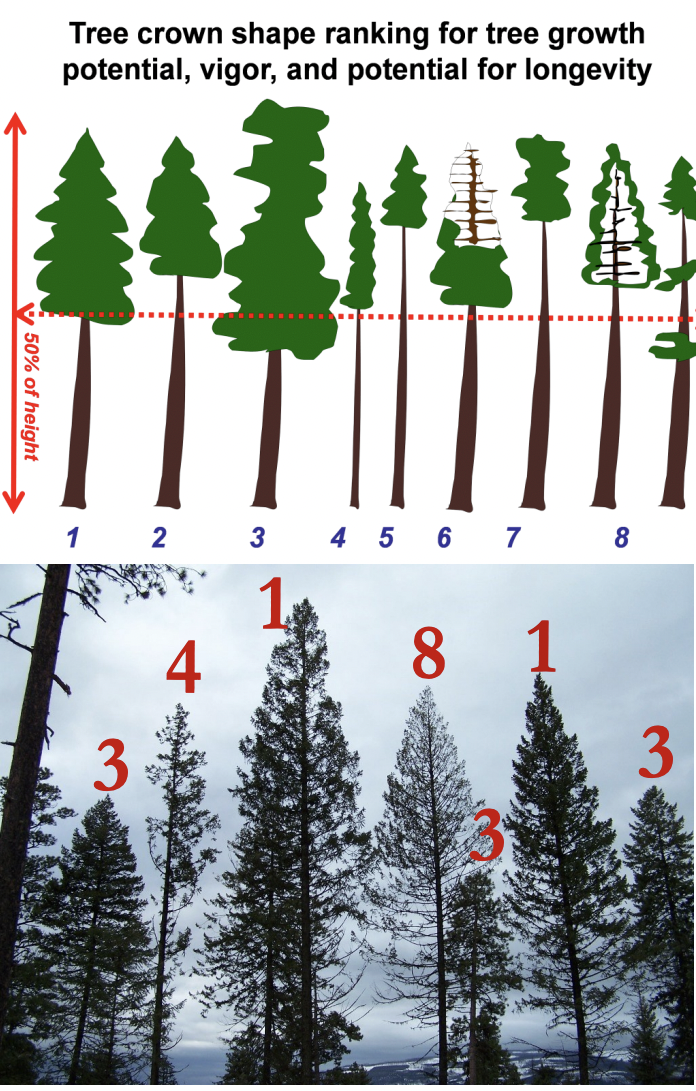
Picture 6. The importance of crown shape has long been recognized by foresters and several crown classification methodologies were developed to assist with tree selection. As a general guideline, trees that have between 1/2 and 1/3 of their total height occupied with a living needle cohort are considered to have enough leaf area to allow for full photosynthetic capacity and thus have abundant energy for growth and defense (1 & 2 rating). However, such trees are quite often not found in a densely grown stand of trees. Thus crown shape was added as an indicator for a tree’s ability to develop a full crown. A pointy crown indicates that the tree can grow taller and develop an optimal crown shape even if it does not presently have one (4 & 5). A flat or rounded top tree crown indicates that the tree’s effective maximum height has been attained, and thus it cannot grow a larger crown area by growing taller (3 & 7). If the tree is flat topped, but retains an adequate crown (>30% of tree height - #3) it has what it needs and is considered a healthy crown. Alternatively, if the crown is flat topped and only a small percentage of the tree height (#7) then it is constrained in energy production and does not have the ability to grow out of this situation. Another common visible crown issues is limited needle retention (#8) that is an indicator of either a pest/pathogen infection or severe site drought conditions. Dead tops (#6) can have many causal factors and its cause and tree consequence is very tree species dependent.
Tree crown size is the easiest starting point. A tree that carries lateral branches with healthy needles for 1/2 to 1/3 of the total tree height indicates that there is ample photosynthetic area for good energy production to support all of the trees physiological needs (Picture 6, tree crowns #1 & 2). Too large a crown area can result in greater water requirements, that across the arid Northern Rockies could result in too much crown water loss and increased stress from summer drought. Less crown area might result in inadequate photosynthesis and constraints on energy availability for growth and defense. A tapered pointed top to the crown indicates the tree is growing taller, and thus still capable of adding more crown area. A flat topped or rounded crown (Picture 6, #3) indicates the tree has reached close to its maximum height potential. This is significant for two reasons. First, as trees age, they slow in their growth rate potential. For most tree species this occurs close to 120 years of age and is referred to as “culmination of mean annual increment” - or the age when the maximum growth rate of a tree is no longer achievable. Second, and perhaps more importantly, a flat top indicates the maximum height to which a tree can efficiently transport water to its needles to compensate for water loss. When reaching this height, the terminal leader is chronically drought stressed, dies back, and lateral branch growth is more prevalent. The drier the site (low humidity and soil water availability), the shorter the vertical distance a tree can effectively transport water against gravity to maintain crown water demands, and the shorter the mature height that a tree can grow to.
For a tree with a healthy crown, a flat toped crown is not catastrophic since it has enough needle area to produce a net positive sugar flow to support itself. There are many ponderosa pines and western larch trees that have survived for 300+ years past the time they developed a flat topped crown and still survive at ages of 500+ years . Alternatively, for Douglas-fir this is a stage where it is increasingly susceptible to Douglas-fir beetles and spruce budworm, for Engelman spruce the risk of spruce bark beetle increases, and lodgepole pine is more prone to being attacked by mountain pine beetle. Insect and disease attack, however, also depends on many other factors, including tree density, competition for water and drought stress, crown energy production potential, prevalence of a single species (food source for an outbreak to develop) across the landscape, individual tree genetics, and soil nutrition. Most shade tolerant species, with the exception of western red cedar, are shorter lived than sun tolerant species (with the potential exception of lodgepole pine). This is due to a shallower root system that makes shade tolerant species more sensitive to episodic drought periods, and possibly less developed defense mechanisms against insects, diseases, and wildfires.
Flat or rounded top trees that have been excessively crowed and shaded by surrounding trees (#7 in picture 6), have small round toped crowns. For these trees, a diminished crown area also indicates a smaller root system and less water absorption capacity. Giving these trees more space typically only has a minimal impact since they are incapable at this stage of growing back a larger crown. They have reached their maximum height and can only grow wider crowns, which is limited by branch strength and wind firmness. Inability to grow larger crowns also limits the trees ability to expand its root system. Trees of this crown character are mostly confined to their present proportions, and usually are at high risk from drought stress and stem failure from the drying effects and torque of increased winds, increased temperatures from more sunlight, and potentially insect and disease attack. The failing crowns of trees in picture 4C might be best explained by the effect of these influences.
Intermediate and suppressed crowns can be difficult to evaluate and much depends on the tree species (Picture 6, #’s 4 & 5). Younger trees that are growing in a small opening with episodic sunlight will often show phototrophic growth and develop a very long and thin leader with sparse and shorter lateral branches and a spindly stem. These trees have the potential to develop well proportioned crowns and roots, but respond best to gradual increases in sunlight brought about with periodic and moderate removal of the surrounding and competing trees. Too much space, created too quickly, leaves them highly susceptible to wind or heavy snow bending, from which they cannot recover. Typically shade tolerant species tolerate and develop quality crowns more quickly than sun tolerant species because they retain more foliage (#4, picture 6) that can develop with more space. The danger for them is sun-scalded foliage if given too much space too quickly. Sun tolerant (shade intolerant) species will drop their lower branches and maintain a smaller pointy top (#5, picture 6). The overall diminished crown size leaves them highly susceptible to wind and snow damage after release, though they do not sun scald as easily and their deeper rooting habit is not as impacted by warmer and drier shallow soils. Both shade and sun tolerant trees within this crown category develop best with a gradual release from surrounding crown competition.
The final categories of crowns include those with dead tops, forked tops, and thinning tops. These symptoms are typically caused by either past damage from animals, insects and diseases, or double terminal buds. The future of trees within this category is highly species dependent. Ponderosa pine and western larch tolerate and often recover from top damage. For Douglas-fir, grand fir and subalpine fir a dead top is an indicator that the tree will have a significantly shorted lifespan and already has or will develop stem decay issues from invasive fungi. Overall, crown categories #6 and #8 from picture 6 indicates severe problems, and a higher probability that the tree will not survive past the next 10 years.
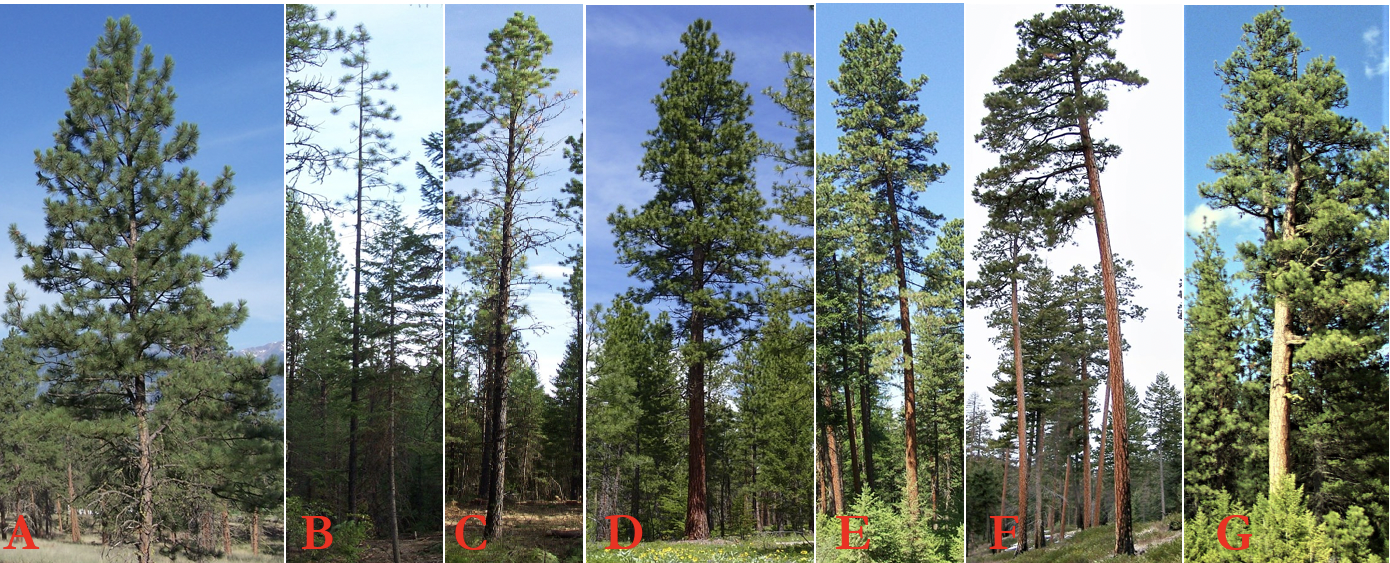
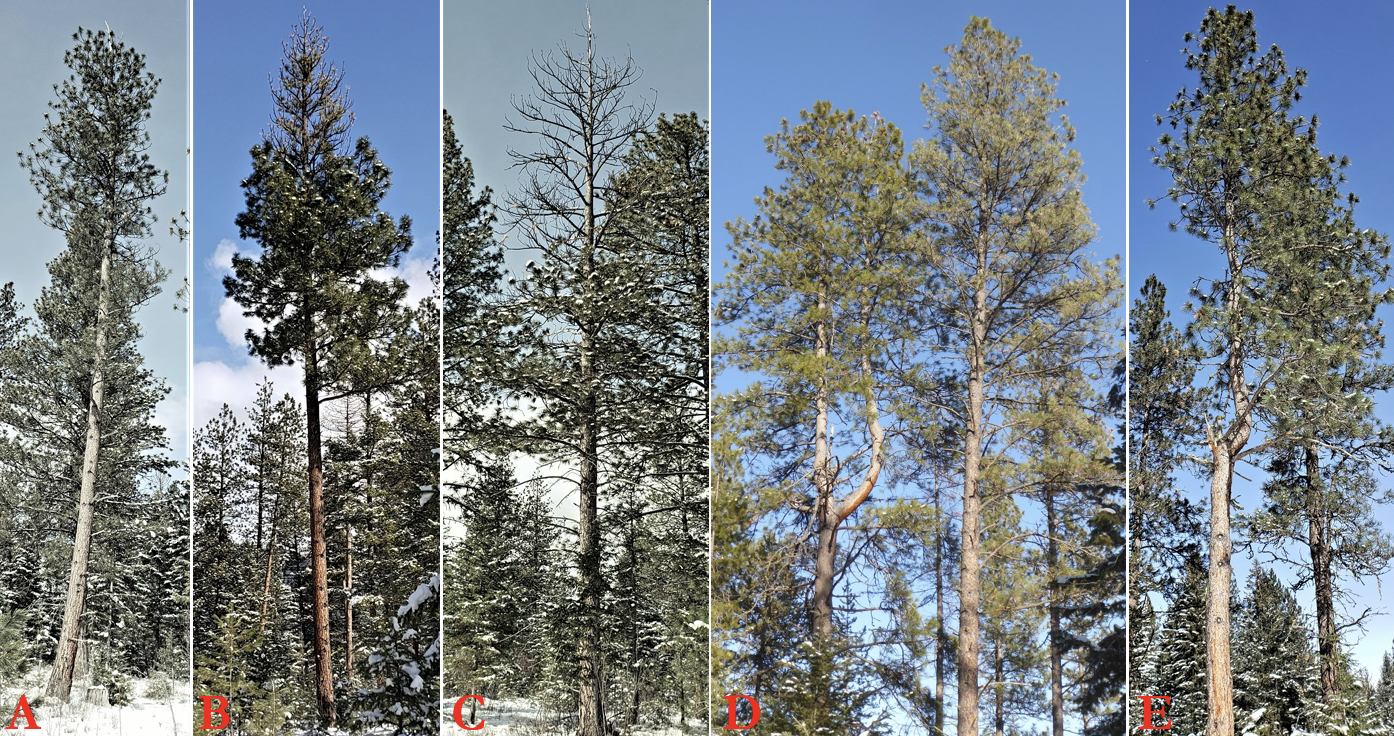
Picture 7. Ponderosa pine crowns
It can develop an extensive tap root system allowing it to find water in deep soils and rock fissures and survive on very dry sites. Surprisingly its roots can also tolerate significant flooding and its taproot ends can be found submerged in stream bottoms. In areas with a high water table, ponderosa pine has the versatility to develop a relatively shallow root system. It is also quite cold tolerant and can be occasionally found on higher elevation sites. Its heavy cones and seeds do not allow it migrate very quickly, unless facilitated by a bird or other animals transporting and caching its seeds, which might explain absence in certain areas of Montana (such as the Bozeman area) although it grows quite well there. Its crowns are adapted to reflect excess sunlight and disperse heat, which makes it shade intolerant. When it has enough space it will develop a symmetrical crown (A) and exhibit rapid growth. When too crowded as a juvenile it can exhibit rapid height growth to track light in the upper canopy. This occurs at the expense of stem diameter (B) growth making this crown type very susceptible to bending or breaking from heavy wet snow, especially when thinning around it gives it too much space all at once. Over time excess crowding will cause the tree to lose its lower branches leaving it with a small crown (C) that is also prone to breakage and windthrow if given too much space quickly. Both B and C crowns respond best to moderate thinning of surrounding trees that over time allow the crown, stem and root system to expand and provide more balance and stability to the tree. As ponderosa pine matures it will reach its maximum height (D) based on its ability to transport water up the stem from the soil in a manner that can keep up with evaporative water demand to the crown. If too long a delay occurs, the crown leader(s) will die-back from drought stress (E & F) creating a rounder and eventually flat topped crown. The lower the summer humidity and thus the greater the evaporative demand, the shorter the mature height of ponderosa pine. It can take about 150 years for ponderosa pine to reach its terminal height and start developing a more rounded crown, but as long as the tree maintains somewhere close to a 30% crown-height ratio it can survive past 500+ years.
Although younger (10-30 year) and mid-mature (30-90 year) ponderosa pine are fairly tolerant of climatic fluctuations on most sites, more mature ponderosa pine can be more sensitive to changes in their surroundings— and can be affected by rapid changes in local climate and soil water balance. Rapidly growing pines that are suddenly drought stressed seem to be a favorite food for western and mountain pine beetle as they are full of nutritious sugar but lack the water pressure to push defensive pitch to attack sites. Thus younger mature trees that appear to have a perfect full crown and good growth rates (distance between whorls of branches) that have quickly grown into a crowded forest condition, or that are subjected to sudden drought might be the first trees attacked and killed. Pine engraver is an indicator of drought stressed trees by killing the tops of water stressed mature trees (G), and stagnated pole sized trees midsummer. Ponderosa pine has pitch canals in its wood that can be very quick to create a “pitch” seal and block off damaged areas. This immune response might also make the tree more resistant to future beetle attacks. Many very old mature trees show they have survived past top-kill from either lightning (pine is an attractive tree to lightning ) or from pine engraver. Although ponderosa pine is good at avoiding drought with deep roots, competition with Douglas-fir, that can dry down its water suction significantly more than pine, can be detrimental. Douglas-fir can obtain water from drier soils than ponderosa pine, and this may also allow it to parasitize water from the pine root systems. Water parasitism among species has been well documented, though not yet studied between these two species. Douglas-fir regeneration often crowds around mature pine trees, that coupled with its greater water suction would indicate this interaction at play.
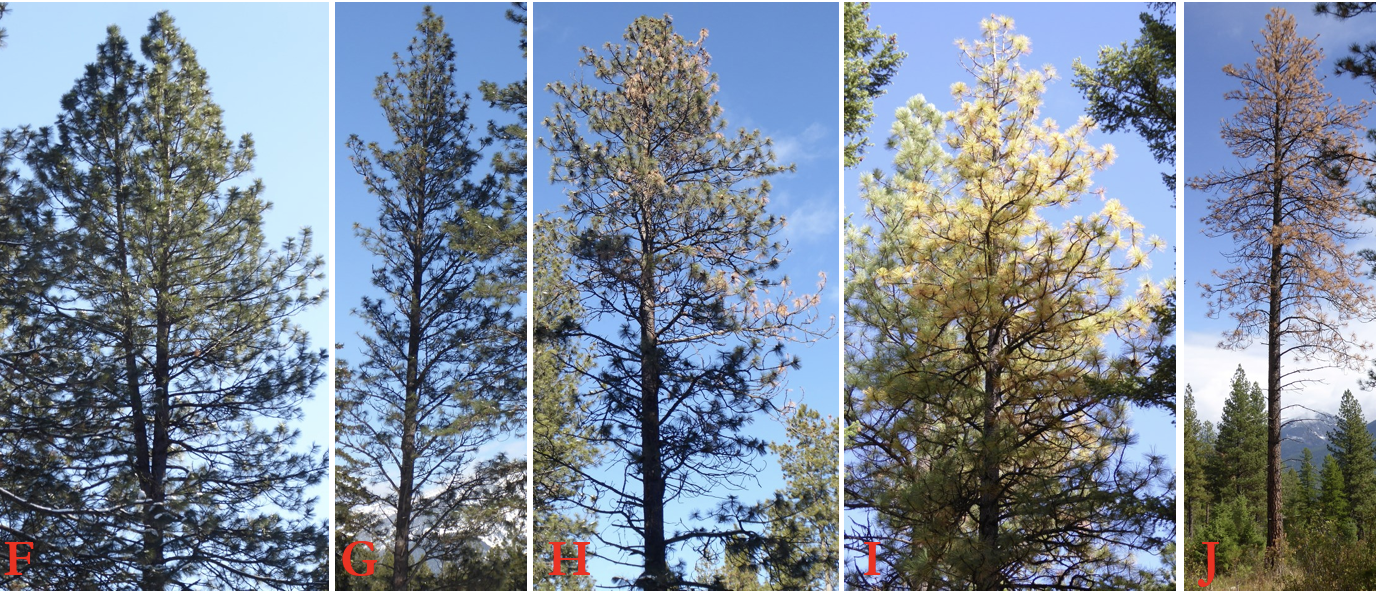
Picture 8. Ponderosa pine and western larch can sustain top dieback from a variety of agents and to different levels of damage, but fully recover from them with some change to their stem form (A, B, C). A “U” shaped fork (D) or what is referred to as a “dogleg” (E) in the stem is the result of damage to the main leader when the tree was younger, and many ancient trees of these two species exhibit such past injuries. A “U” shaped fork is different than a “V” shaped fork (F) that results from a double terminal bud. Forks that result from injuries develop when lateral branches develop dual dominance, and the wood fiber grows across the fork, forming a very strong and stable fork. A “V” shaped fork develops with a parallel wood grain that has no lateral connection and strength and is thus very prone to splitting the tree trunk when one fork has more wind or weight exerted on it. A fork near the middle of the tree is a much greater risk to the tree than a fork that has developed near the top of the crown. More vertical branch angles (G) causes greater wood defect in the tree stem for wood production, is genetic in origin, and might be linked to greater susceptibility to gall rust and other needle and stem pathogens, but this has not been carefully studied or substantiated. Spotty or irregular branch dieback (H) is consistent with disruption of water flow to the crown from root diseases and stem pests and pathogens. The pictured example is being caused by persistent turpentine beetle infestation on the lower stem. A sudden yellowing crown (I) indicates a serious disruption of water flow to the crown for which there might be a variety of causes, leading to tree death. A red or orange crown (J) indicates total water-flow blockage for which there is no possible reversal (the tree is dead).
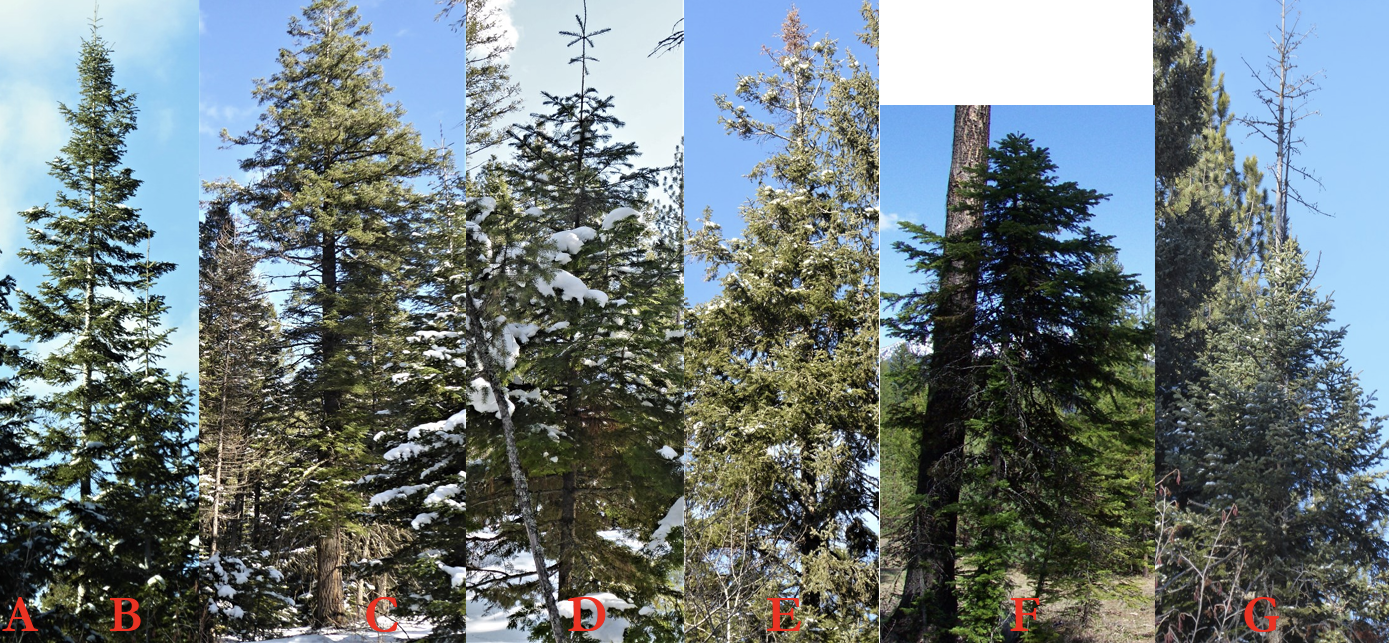
Douglas- Fir is a highly adaptable species, and is the most commonly found tree species across the Northern Rockies. Its adaptability as a young tree can make it complicated to assess and manage once mature. With moderate to full sunlight it grows well and develops an extensive crown both as an overstory tree (A) and understory tree in partial shade (B). This gives it the ability to grow as both a pioneer and climax tree in moderately dry to wet environments. As is matures (around 120 years) it develops a rounded top (C) and self shading reduces its lower canopy needle area. The partial shade tolerance of Douglas-fir makes it it's own worst enemy, allowing it to develop into dense overcrowded stands where canopies intercept rain and snow that evaporates back into the air rather than hydrating the soil. This along with a dense needle area (that has significant water needs), allows Douglas-fir to develop into stands that have outgrown the capacity of the site to support them with adequate water. When Douglas-fir regenerates as a mostly even-aged seeding cohort following a disturbance such as fire, mountain pine beetle outbreak, or thinning, it quickly develops into an overcrowded stand where light and soil water competition creates trees with narrow and shallow crowns (E), and proportionally small and shallow root systems. As trees reach their mature size, most crowns become more rounded (F) or broader with moderately pointed tops. In such crowded stands, mature trees shade each other into developing very shallow and short crowns, often covering less than 10% of their height. Thinning stands of trees in this condition is very difficult as they cannot adapt well to more sun or increases in soil temperature. If thinning is applied on sunny south and west aspects it must be very gradual (perhaps less than 30% of the trees can be removed) to maintain soil shade. North and east aspects are more forgiving. Group selections or “patch” cuts might be better management solutions for mature stands with poor crowns.
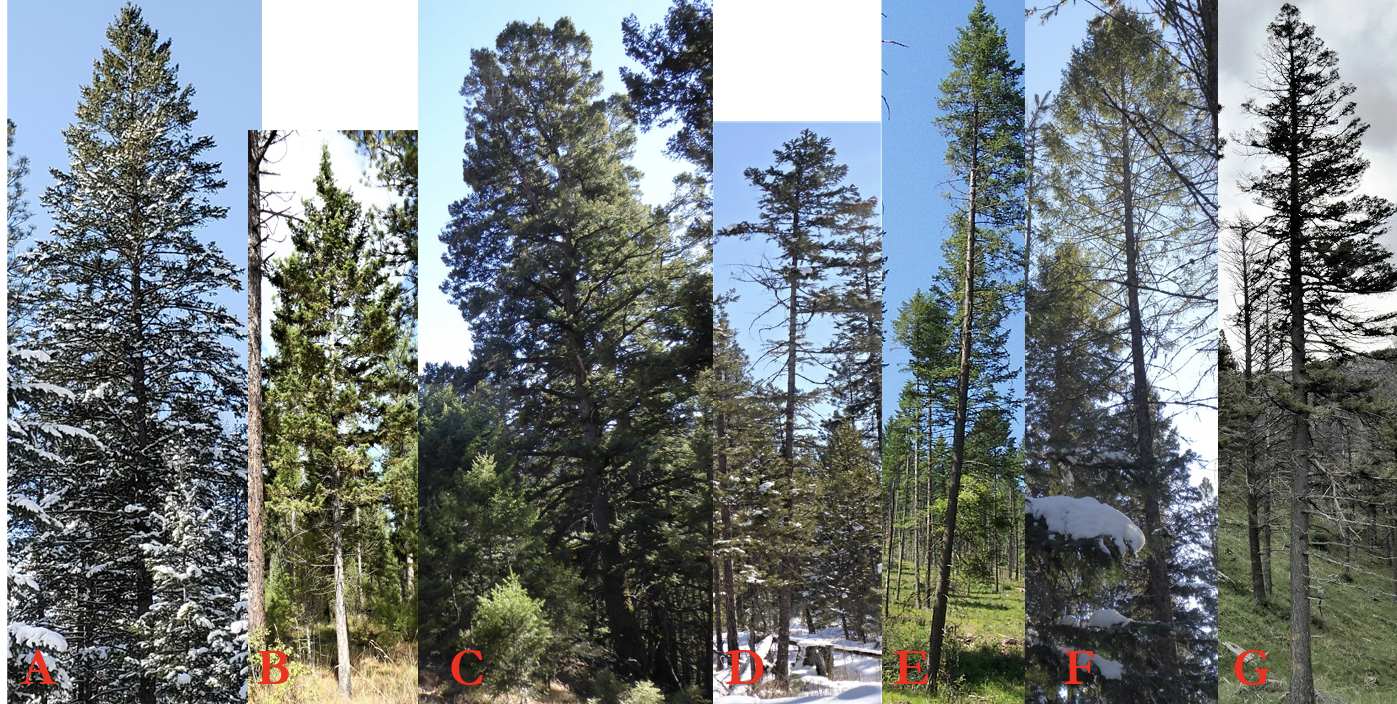
Picture 9. Douglas-fir crowns
Douglas-fir may regenerate in spotty patches under a dense closed canopy forest, but it is not a fully shade adapted species, and deep shade, along with root competition from neighboring trees will result in stunted smaller trees with wide shallow crowns (D). When establishing under western larch or ponderosa pine dominated overstories, enough light penetrates these deciduous and more open crowned trees to allow Douglas-fir to develop a more aggressive and rapid growing crown such as seen in (B). Whereas understory Douglas-fir with a “B” crown can take good advantage of more space from thinning and grow into a well proportioned mature tree, a “D” crown tree may never release, or take decades to develop a more robust crown and root system that can support better growth. Smaller trees with “D” crowns have occasionally been measured to be over 100+ years old. The older they are with this type of crown, the less likely they are to respond to more space and develop into bigger trees.
Open grown Douglas-fir with “A” or “C” crown shapes may survive for close to 400 years. Older Douglas-fir may exist but are quite rare. Douglas-fir can be expected to develop a “C” crown at around 100 years, and 200 years average age is not uncommon for “old growth” stands with “F” crowns . This species can develop a deeper root system as it is somewhat tap rooted, though when it develops in dense even-aged stands a shallower root distribution is often observed. This may be exacerbated by shallow soils that are common on mountain slopes. Crowded Douglas-fir stands can develop root grafts between individual trees, responsible for creating the “living stump” phenomenon. After tree removal occurs, some stumps and their root systems remain alive decades after being cut. Grafted root systems among mature trees provides neighbor trees access to water acquisition from cut tree root systems, and sugar from the intact surrounding trees diffuses across the root graft into the cut tree root systems keeping them alive.
Grafted root systems may offer trees an advantage for water and nutrient acquisition, but also come with significant disadvantages. Specific fungal root diseases such as Armillaria, Schweinitzii, and laminated root rot will infect root system of susceptible trees, and follow root grafts into other trees creating what are termed “root rot pockets”. Infected trees will develop a “G” crown noticeable as poor needle retention and “thin crowns”. Such crowns indicate the tree will likely die within the next 5-15 years. Root disease is particularly common where Douglas-fir are mature, and have persisted for multiple generations (C and F crowns), or on wetter forest types such as where grand fir and wester red cedar are the climax species. This offers additional challenges for stand improvement practices because thinning mature trees to relieve drought stress also creates food sources that may stimulate root diseases. Thinning Douglas-fir stands to alleviate water competition is best recommended when trees are young or have A, B and sometimes E crowns.
Picture 10. Grand fir
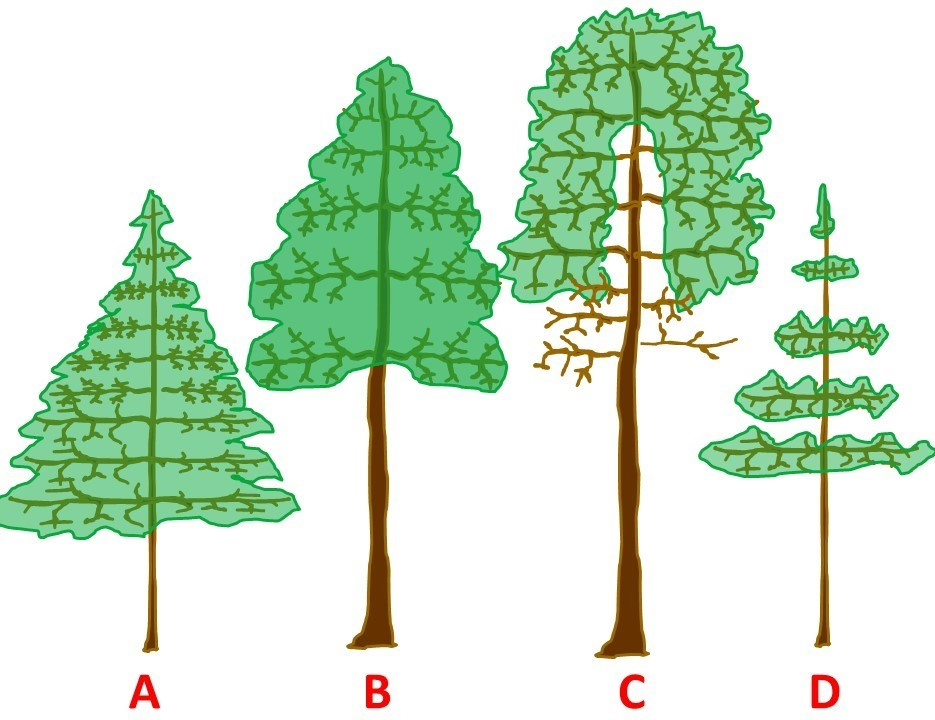
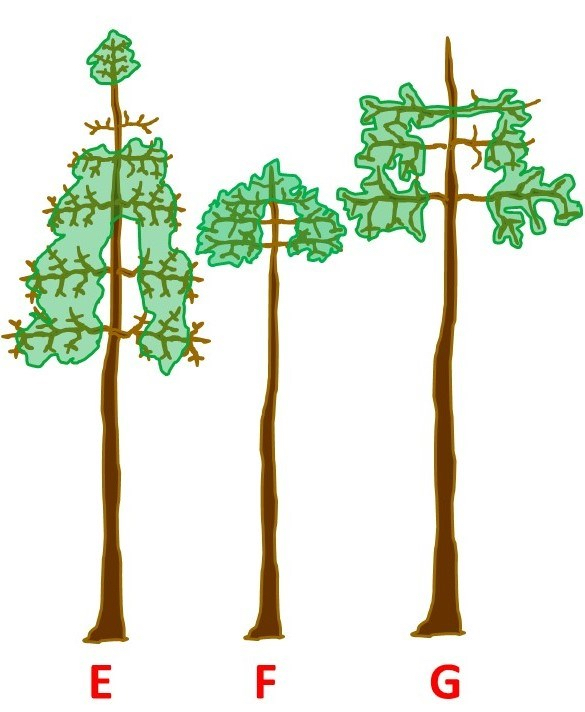
Grand fir is quite shade tolerant and capable of very rapid growth. It is good at maintaining a full crown (A, B) even as a very mature tree (C). Partial shade will stimulate rapid leader growth (D). Too much shade will also stagnate its growth (F) from which it has difficulty recovering. It’s downfall is great sensitivity to water stress and poor defenses against a host of pests and pathogens. Water stress can result in leader dieback (E, G). Spruce budworm and Tussock moth will also defoliate tree tops, that can grow back into what is called a “fiddle top” (E). Seasonal drought makes it extremely susceptible to fir engraver bark beetle that will also cause top dieback or sudden tree death. Its retention of good crown shape and volume can be misleading as Indian Paint fungus (Picture 11) commonly invades and decays the center core of the tree. Any presence of a conk on the stem indicates it is completely decayed inside making it unstable and worthless as a wood source. It is rare to find healthy intact grand fir that are older than 200 years.
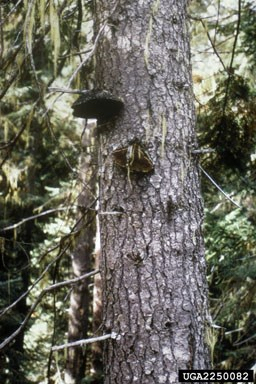
Picture 11. Indian paint fungus conk
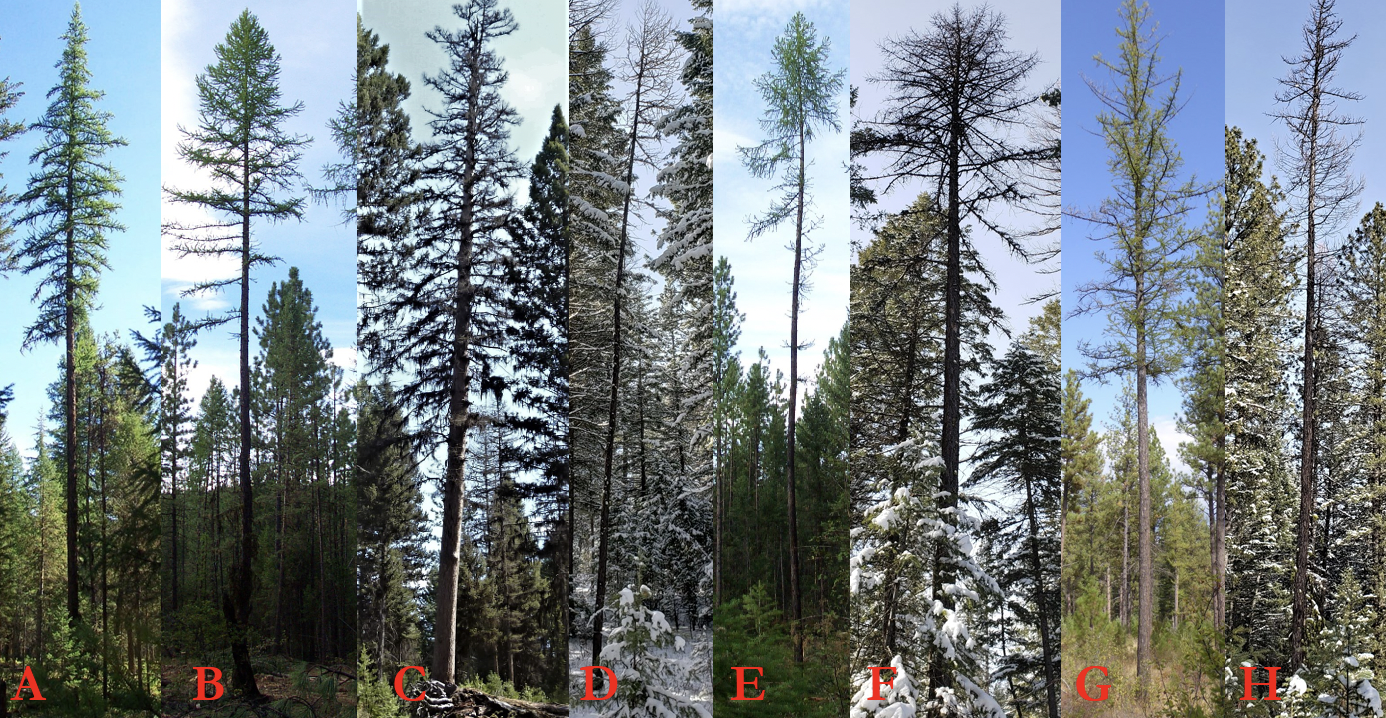
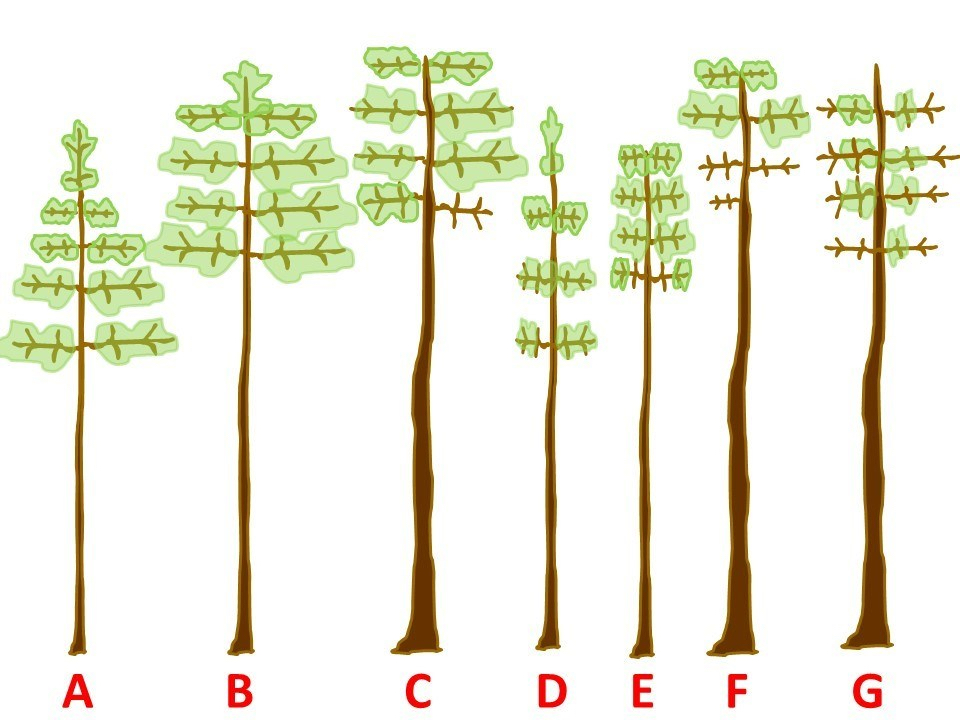
Picture 12. Western Larch
Western larch is the ultimate survivor where it grows. It is quite shade intolerant and is well adapted to colonize burned and heavily disturbed sites. With enough space it grows quickly with well formed crowns (A and B). As a juvenile it grows with rapid height growth, but easily stagnates from light competition with surrounding trees. If caught early (D) it responds well to thinning, but if in a dense condition too long (E) it may take a decade or more before it starts to grow well again. It is highly susceptible to late spring snowfalls of heavy wet snow that stick to new needles that may permanently bend over the stem. Once it matures it forms a flatter or wider crown (F). Any shade will cause it to drop its lower limbs, which reduces crown volume. Larch is one of a few trees that can produce “Lammas” growth—or adventitious branches later in the summer, and thus is good at recovering from injury. It may be one of the longest lived species in the northern Rockies living up to 1000 years. Older trees are often infected with brown heart rot and carpenter ants making it an ideal habitat tree, especially for Pileated woodpeckers (C). Swollen branch connections to the main stem, visible fungal conks and occasional branch dieback (G & H) usually indicate that the heart wood is decayed, though infested trees can survive for many centuries with this condition. Larch starts to occur across wetter Douglas-fir sites, and is sensitive to drought stress that can also show itself as branch and especially terminal leader dieback. The most fire resistant tree in the northern Rockies, it can survive significant fire damage to its stem and crown. The former record giant larch in Montana survived for decades with just one lateral branch keeping it alive. Many of the ancient larch (C) approaching 1000 years of age had experienced dead tops from which they have recovered.
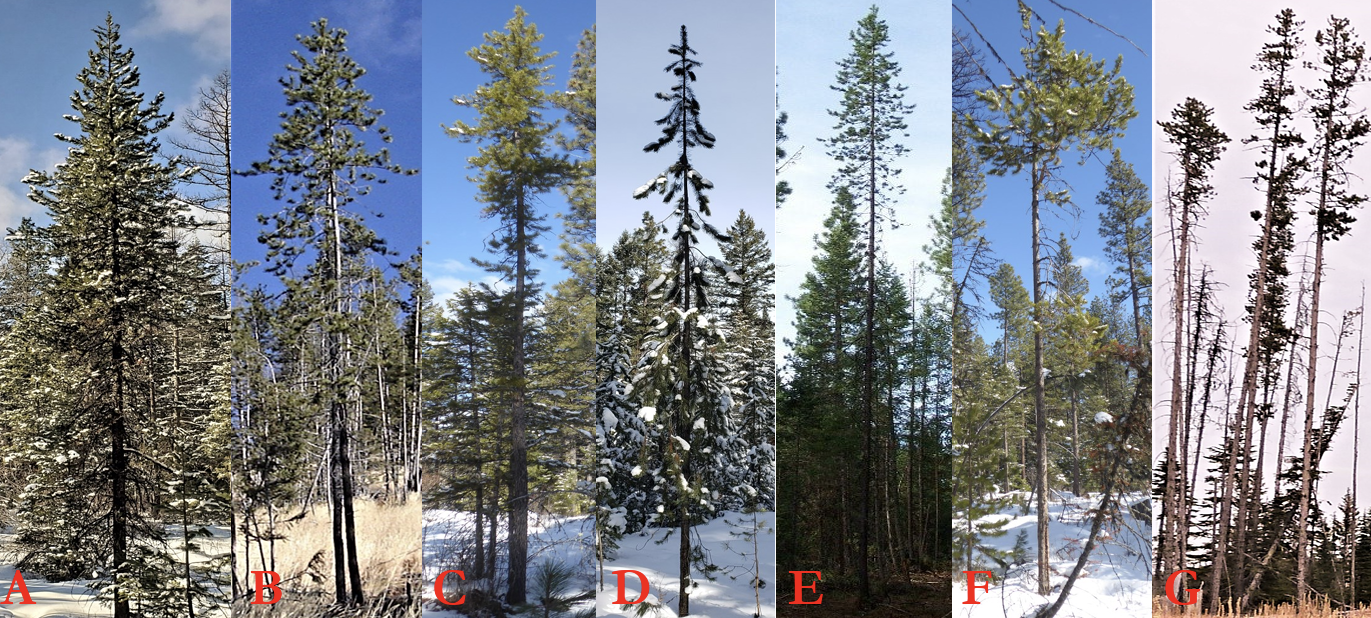
Picture 13. Lodgepole pine
Lodgepole pine is an often maligned species because of its common occurrence as dense monocultures on landscapes that experienced infrequent and severe wildfires, and its susceptibility to mountain pine beetle outbreaks when it reaches 80+ years of age. It is a shade intolerant species that is relatively fast growing on poor as well as good soils, and with enough space, it develops a fairly symmetrical crown (A & B). If open grown it will retain all of its branches to ground level, though with moderate shade from competing trees it 24 will let its lower shaded branches die. Shaded branches smaller than 1 inch diameter will typically self prune, whereas larger branches will persist for decades. At close to 90 years lodgepole pine will develop a flat topped crown (C) and growth will start to slow. If it can maintain a healthy crown and is not attacked by mountain pine beetle it may attain an age of 300 +years, though this is not common and usually occurs when it is an isolated tree growing within a forest of other species. Since lodgepole pine regeneration is adapted to take advantage of severe disturbances, it often develops in very dense pure stands, that can start to stagnate at 5 years of age with 5-20 stems per square yard. This kind of extreme crowding creates tall thin crowned saplings and poles (D), that over time will self-thin to some level, but result in stands of small crowned trees (E) that over time can stagnate as stunted mature trees with small flat topped crowns (F). These crowded stands of trees are frequently drought stressed during the summer and when stems reach a diameter (8-10 inches) that can support mountain pine beetle larvae, they are attacked and become breeding grounds for bark beetle outbreaks. On better soils, dense stands of lodgepole pine can reach 80 ft in height and stem diameters approaching 20 inches (4.5 ft from the soil surface). Lodgepole pine develops a very limited vascular system for transporting water (also called xylem or sapwood) that reduces water transport to taller crowns and can result in trees slow decline (G). Once a lodgepole pine crown has reached a mature height with a flat top and less than 20-30% crown (% of the total height) it will have minimal response to more space, water and nutrients. Thinning and spacing dense lodgepole pine stands at the sapling, pole sized, and mature tree stages will allow it to develop an optimal grown, good growth and greater longevity. The state record lodgepole pine is 3 feet in diameter and approximately 120 feet tall. Lodgepole pine is adapted to grow at mid to higher elevations where a shorter growing season and deep snowpack limits summer drought. It will also occur in riparian areas, though is often plagued with stem and branch fungal diseases such as western gall rust and stem canker diseases. When lodgepole pine occurs as individual trees in mixed species stands it often persists into an older age than when it occurs in a monoculture. With its serotinous cones, it is the only species whose seeds can surviving a severe crown fire, and can be an important component for ensuring some natural tree regeneration following a wildfire.