

The Back Cover
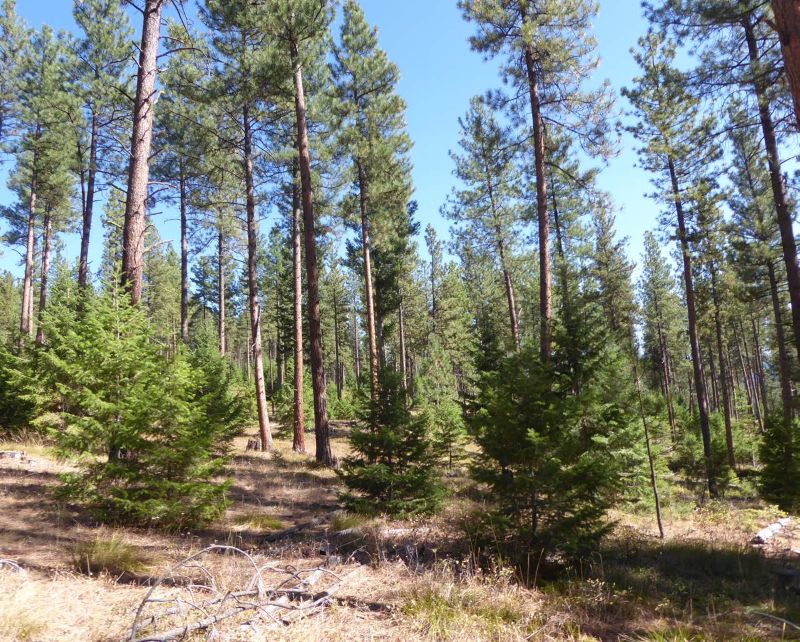
Photo: Peter Kolb, MSU Extension Forestry Specialist
The front cover shows the tree species diversity typically found across the wetter NW forests of Montana that is heavily influenced by Pacific coast weather patterns. The back cover shows the dry ponderosa pine/Douglas-fir forest type that is the most common found across the state and more strongly influenced by a continental climate.
The dynamic between ponderosa pine and Douglas-fir is more complex than may appear. The strong tap root of ponderosa pine allows it to colonize hot, dry sites and find water at great depths, allowing it to persist for many centuries and survive drought, frequent fires, and most insects and diseases. Pictured are the surviving trees of a 30-year thinning study, where the most resilient trees had been spaced at 20-30 feet, and the tighter spaced trees at 14 or 16 feet proved more susceptible to attack by bark beetles during a multi-year drought from 2005-2010. The catch-22 is that wider spaced mature ponderosa pine allowed for more prolific natural regeneration and invasion of more shade-tolerant Douglas-fir. Whereas ponderosa pine is a “drought avoider” by finding deep water sources, the somewhat shallow-rooted Douglas-fir is a “drought tolerator,” surviving in much drier soils than ponderosa pine. Although not studied for these two species, other tree species that can dry down as much as Douglas-fir exhibit water parasitism mechanisms, literally “sucking” water out of tap-rooted adjacent trees by creating a lower water potential (-28 bars water potential for Douglas-fir versus a minimum -18 bars water potential for ponderosa pine). Observation has shown this is highly likely a mechanism used by Douglas-fir.
The conundrum for all foresters managing ponderosa pine and Douglas-fir together is whether or not to leave only the ponderosa pine that has greater resilience and faster growth rates on such sites, but a very poor market for wood products, or to leave a mixture of the two species, knowing the Douglas-fir has a shorter lifespan (200-350 years on average) than ponderosa pine (300-700 years), and less ire resilience, but is a preferred species for sawmills that want quality wood. Growing the two together in a two-age strategy may provide the ideal solution, where widely spaced ponderosa pine is cultured as a legacy species to be left on site in perpetuity, and Douglas-fir is managed as an interspersed wood product on a 80-200 year harvest rotation, growing between old-growth pine in multiple rotations. The biggest challenge will be controlling prolific Douglas-fir regeneration that has potential to create excessive soil moisture stress and wildfire potential.