

Secondary Beetles Attacking Stressed Trees
By Amy Gannon — Department of Natural Resources & Conservation (DNRC)
Large pockets of red, dead trees are increasingly familiar on hillsides around western Montana. Having been through landscape-scale bark beetle outbreaks, we generally assume these dead trees have been attacked by Douglas-fir beetle, mountain pine beetle, or other common, charismatic Dendroctonus beetles.
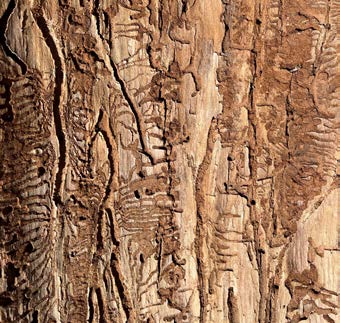
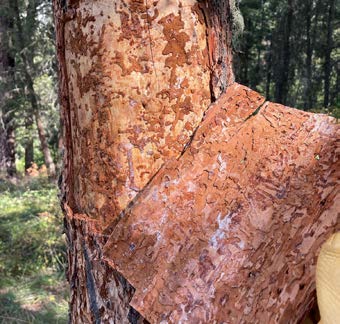
Douglas-fir beetles bore into weakened, damaged, or unhealthy trees and leave behind orangish-brown dust in bark crevices. Below the bark, beetles create distinct vertical galleries parallel to the wood grain and fan out in a feather-like pattern (Image 1). Another beetle however, the flatheaded fir borer, has become increasingly common in large trees of all species. The beetle itself is much larger, but its presence can be much more subtle. The underlying tunnels are wide and meandering compared to the organized galleries of the Douglas-fir beetle (Image 2). Flatheaded fir borer infestations are easiest to spot when woodpeckers chisel bark off the main bole in search of nutritious beetle larvae.
Mountain pine beetle is another familiar beetle that made an indelible impact throughout pine forests during the most recent outbreak (approximately 2009-2015). Pine trees were killed on nearly six million acres in Montana, with dead trees still bearing the telltale galleries the beetles left behind (Image 3). While mountain pine beetles are still present at low levels, much of the current mortality in pine can be attributed to wood borers, pine engravers, or other secondary beetles.
Secondary beetles successfully attack trees that are stressed by chronic conditions (root disease, drought, etc.) or sudden events (high temperatures, fire scorch, storm damage, etc.). Independent of the underlying cause, these beetles ultimately kill trees and have been noted in Douglas-fir, ponderosa pine, and western larch. It might seem that Montana is having an outbreak of secondary beetles, whereas, in fact, the trees are simply succumbing to ongoing or extreme stress.
This phenomenon is not limited to Montana. Other states in the Intermountain West and north into Canada are reporting similar mortality patterns. These observations raise questions about the uptick in wood borer and secondary beetle damage. Is it triggered by a long-term drought, or by a more specific event such as the “Heat Dome” of 2021? Is this a one-time occurrence or should we expect continued mortality?
Regardless of the cause and forecast, prevention is the most reliable management option. Pheromone packets used to repel Douglas-fir beetles (MCH) or mountain pine beetle (verbenone) are NOT effective against wood borers or other secondary beetles. The best way to limit tree mortality is by promoting tree vigor and resilience through active forest management.
 |
 |
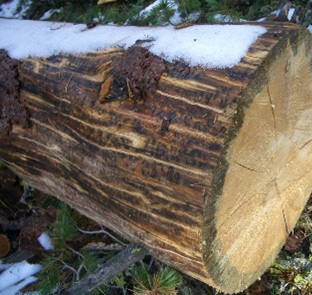 |
| Image 1. Organized galleries made by Douglas-fir beetle. Photo: A. Gannon, DNRC | Image 2. Wide, meandering tunnels created by wood borers. Photo: C. Foelker, USFS | Image 3. Persistent galleries left by mountain pine beetle. Photo: A. Gannon, DNRC |