

Montana Family Forest News 2025
What is Climate Smart Forestry?
Issue No. 52
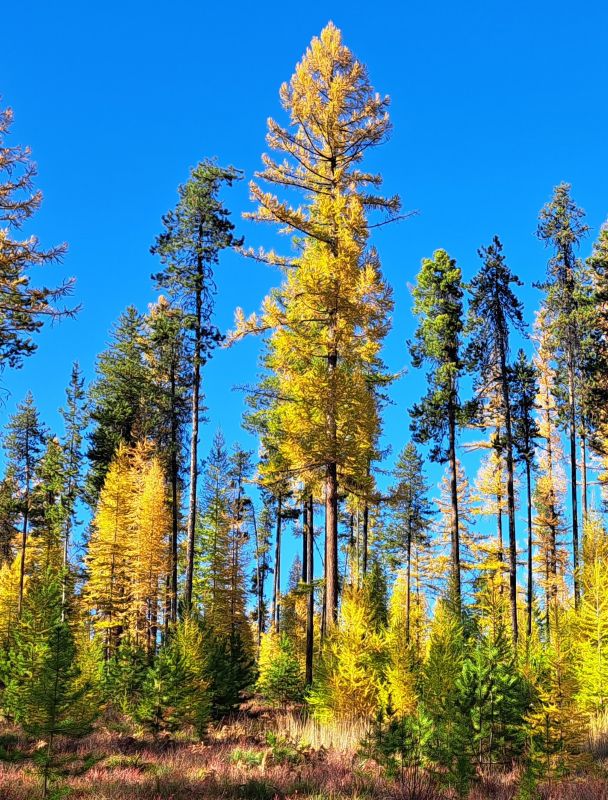
Cover Photo: Peter Kolb, MSU Extension Forestry Specialist
This newsletter is possible through funding from the Renewable Resources Extension Act (RREA). It highlights numerous articles focused on information and resources that forest landowners can use to better their knowledge and potentially implement on their own land. The overall concept is to provide articles that capture one’s attention based on current issues and updates on various organizations on a state and national level. Our goal is to provide articles that will give important information and encourage landowners to develop new ideas toward their land.
Every year our newsletter has a specific forestry related topic. Past newsletters can be viewed on our website under “Montana Family Forest News.”
Editor
Peter Kolb, MSU Extension Forestry Specialist
Advisors
Lexi Brown, MSU Extension Forestry
Forest Stewardship Coordinator
Christina Oppegard, MSU Extension Forestry
Program Manager
Financial Contributors
Montana Tree Farm
Montana Stewardship Foundation
Montana Forest Owners Association
Montana State University Extension



About the Cover
This mixed stand of western larch, Douglas-fir, lodgepole pine, ponderosa pine and spruce resulted from logging in the 1910-1920s and another entry 30 years ago. Located in the Lolo National Forest adjacent to private lands, the first harvest occurred with axes, crosscut saws, horses, oxen and steam engines, where all large, old trees that had value were clearcut. Some old trees with stem defects were left along with any advanced regeneration. The level of disturbance created provided a good seedbed for natural regeneration, especially for shade-intolerant species such as western larch and lodgepole pine. The relatively flat bench on an east-facing slope allowed for adequate moisture, less intense sunlight and drying common on nearby south and west-facing slopes, and thus, greater tree species diversity. A prolonged cool and wet phase of the Pacific Decadal Oscillation that lasted from about 1944 until 1984 provided summer moisture, a lack of severe fire weather and good growing conditions for developing a productive forest that provided plenty of volume for another timber harvest in the 1980s. Planning and foresight left a mixture of species and good crowns on residual trees that provided seeds for a new young cohort of trees.
What isn’t seen is that every harvest entry into this stand resulted in millions of seeds spreading out, with only a fraction of one percent turning into surviving seedlings competing for light and water on this site. Two harvests over the past 100 plus years resulted in two additional genetic selection processes for each tree species suited to this site for the moisture, nutrients and temperature fluctuations unique to this spot. No harvesting would likely have resulted in bigger and older and more dead trees, but also trees whose genetics were selected for the conditions (including climate) that existed 300 years ago. Whereas it is important to retain old genetic diversity, it is also important for the continued selection of genetics and species that reflect more current climatic conditions after each harvest, a climate that based on recorded data, grew warmer and drier over the past century, especially over the past 40 years. The mosaic of species and age classes shown on the cover page conserves a process where the selection for genetic adaptiveness, and therefore survivability for each species, remains on this site. For forests to be given the best chance to survive future climatic trends and associated weather variability, managing for a diverse forest structure, species variability and broad genetic adaptability may well be the best strategy.
 Peter Kolb, PhD
MSU Extension Forestry Specialist
Copyright © 2025 MSU Extension
We encourage the use of this document for nonproit educational purposes. This document may be reprinted for nonproit educational purposes if no endorsement of a commercial product, service or company is stated or implied, and if appropriate credit is given to the author and MSU Extension. To use these documents in electronic formats, permission must be sought from the Extension Communications Director, 135 Culbertson Hall, Montana State University, Bozeman MT 59717; E-mail: publications@montana.edu
The U.S. Department of Agriculture (USDA), Montana State University and Montana State University Extension prohibit discrimination in all of their programs and activities on the basis of race, color, national origin, gender, religion, age, disability, political beliefs, sexual orientation, and marital and family status. Issued in furtherance of cooperative extension work in agriculture and home economics, acts of May 8 and June 30, 1914, in cooperation with the U.S. Department of Agriculture, Cody Stone, Director of Extension, Montana State University, Bozeman, MT 59717.
The views and opinions expressed in this newsletter are those of the authors and do not necessarily relect the opinion of Montana State University or the sponsors of this publication.